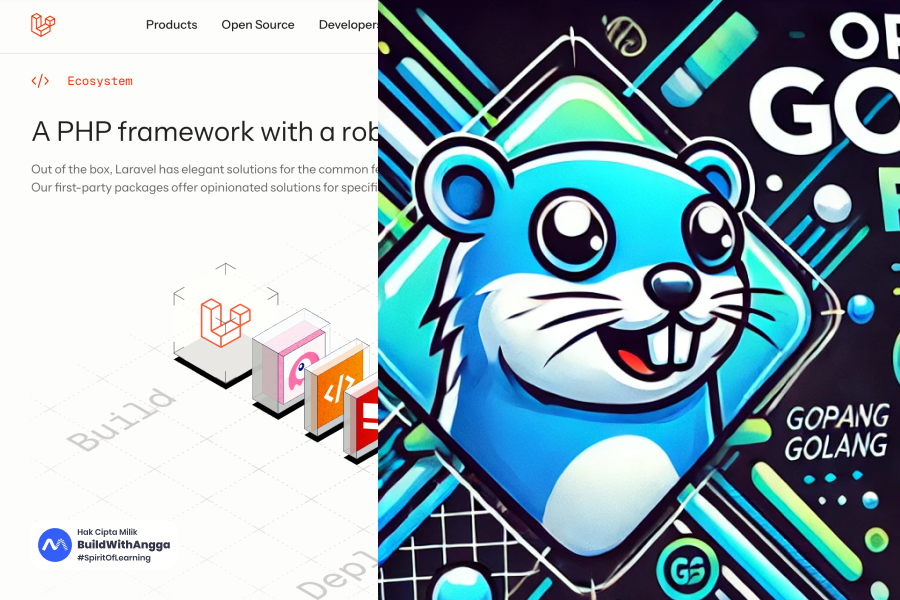
Bingung pilih Laravel 12 atau Golang untuk memulai karir backend developer di 2026? Artikel ini membahas 7 perbedaan fundamental antara kedua teknologi — dari philosophy, performance, syntax, hingga ecosystem.
Dilengkapi contoh koding real-world, perbandingan packages populer (Fiber, GORM, Spatie, Livewire), dan rekomendasi berdasarkan jenis projek dan career path. Panduan lengkap untuk pemula yang ingin membuat keputusan tepat.
Bagian 1: Kenapa Perbandingan Ini Penting di 2026?
Sebagai founder BuildWithAngga dengan lebih dari 900.000 students, saya sering mendapat pertanyaan yang sama: "Kak Angga, untuk backend development, lebih baik belajar Laravel atau Golang?"
Pertanyaan ini semakin sering muncul menjelang 2026 karena landscape teknologi terus berubah. AI dan automation mengubah cara kita bekerja, cloud-native architecture semakin dominan, dan performance menjadi critical factor untuk user experience.
Tapi sebelum menjawab, kita perlu pahami dulu: ini bukan soal mana yang "lebih baik". Keduanya excellent di domain masing-masing. Yang perlu kita pahami adalah kapan menggunakan yang mana.
Laravel dan Golang: Dua Philosophy Berbeda
Laravel adalah PHP framework yang dibangun dengan filosofi "developer happiness". Taylor Otwell, creator-nya, ingin membuat development experience yang menyenangkan dengan syntax yang expressive dan fitur yang lengkap out of the box.
Golang (atau Go) adalah programming language yang dibuat oleh Google dengan filosofi "simplicity and performance". Rob Pike dan tim ingin bahasa yang simple, fast, dan built for scale — terutama untuk concurrent systems.
Keduanya bisa dipakai untuk membangun backend, tapi dengan approach yang sangat berbeda.
Konteks Backend Development 2026
Beberapa trend yang perlu diperhatikan:
TREND 2025-2026:

📈 Growing:
├── Microservices architecture
├── Serverless deployment
├── AI-powered features
├── Real-time applications
└── Edge computing

📊 Still Relevant:
├── Monolithic applications
├── Traditional web apps
├── REST APIs
├── Server-side rendering
└── Admin dashboards

💰 Job Market:
├── Laravel: Stable, banyak di startup & agency
├── Golang: Growing, dominan di unicorn & fintech
└── Kombinasi keduanya: Premium profile
Quick Comparison Overview
Sebelum masuk ke detail, berikut overview singkat:
┌─────────────────────┬─────────────────────┬─────────────────────┐
│ Aspek               │ Laravel 12          │ Golang              │
├─────────────────────┼─────────────────────┼─────────────────────┤
│ Type                │ PHP Framework       │ Programming Language│
│ Philosophy          │ Developer happiness │ Simplicity + Speed  │
│ Learning Curve      │ Medium (2-3 bulan)  │ Medium-High (3-4 bln)│
│ Performance         │ Good                │ Excellent           │
│ Typing              │ Dynamic             │ Static              │
│ Concurrency         │ Limited (butuh ext) │ Built-in Goroutines │
│ Primary Use         │ Web apps, APIs      │ Systems, APIs, CLI  │
│ Ecosystem           │ Mature, complete    │ Growing, modular    │
│ Job Market ID       │ Besar, stable       │ Growing, high salary│
│ Startup Friendly    │ Sangat              │ Medium              │
│ Enterprise Ready    │ Ya                  │ Ya                  │
└─────────────────────┴─────────────────────┴─────────────────────┘
Apa yang Akan Dibahas
Dalam artikel ini, kita akan deep dive ke 7 perbedaan fundamental:
- Philosophy & Design — Cara berpikir di balik teknologi
- Type System & Error Handling — Dynamic vs Static typing
- Performance & Concurrency — Benchmark dan real-world impact
- Ecosystem & Packages — Spatie, Fiber, GORM, dan lainnya
- Development Speed vs Runtime Speed — Trade-off yang harus dipahami
- Learning Curve & Community — Mana yang lebih mudah dipelajari
- Deployment & DevOps — Dari Docker sampai Kubernetes
Setiap perbedaan akan dilengkapi dengan code examples yang comparable — use case yang sama, implementation yang berbeda. Sehingga kamu bisa lihat langsung perbedaannya.
Di akhir artikel, saya akan kasih rekomendasi berdasarkan goals dan situasi kamu.
Let's dive in!
Bagian 2: Perbedaan #1 — Philosophy & Design Approach
Laravel: "Developer Happiness First"
Laravel dibangun dengan satu tujuan utama: membuat developer senang saat coding. Taylor Otwell percaya bahwa developer yang happy akan lebih produktif dan menghasilkan code yang lebih baik.
FILOSOFI LARAVEL:

"Convention over Configuration"
├── Banyak hal sudah diatur dengan default yang masuk akal
├── Tidak perlu configure segalanya dari nol
├── Ikuti convention, langsung jalan
└── Tapi tetap bisa di-customize jika perlu

"Batteries Included"
├── Authentication? Ada.
├── Database ORM? Ada.
├── Queue system? Ada.
├── Caching? Ada.
├── Testing? Ada.
└── Hampir semua yang dibutuhkan sudah tersedia

"Expressive Syntax"
├── Code yang mudah dibaca
├── Seperti membaca bahasa Inggris
├── Banyak helper functions
└── Magic methods untuk convenience

"Rapid Development"
├── Artisan CLI untuk generate code
├── Migrations untuk database
├── Factories untuk testing
└── Dari ide ke production dengan cepat
Laravel adalah opinionated framework — artinya punya pendapat kuat tentang bagaimana sesuatu harus dilakukan. Ini memudahkan pemula karena tidak perlu banyak keputusan arsitektur.
Golang: "Simplicity & Performance"
Golang didesain dengan filosofi yang berbeda: kesederhanaan dan kecepatan. Tim Google yang membuatnya (Rob Pike, Ken Thompson, Robert Griesemer) ingin bahasa yang simple, fast to compile, dan easy to read.
FILOSOFI GOLANG:

"Less is More"
├── Syntax yang minimal
├── Hanya 25 keywords
├── Tidak ada class, inheritance, exception
├── Fitur sedikit tapi powerful
└── Setiap fitur harus earn its place

"Explicit over Implicit"
├── Tidak ada magic
├── Semua terlihat jelas
├── Error handling explicit
├── Import explicit
└── Apa yang kamu lihat adalah apa yang terjadi

"Do One Thing Well"
├── Go adalah bahasa, bukan framework
├── Standard library yang kuat
├── Composable packages
└── Build your own stack

"Built for Scale"
├── Concurrency dari awal
├── Fast compilation
├── Small memory footprint
├── Compile to single binary
└── Designed untuk distributed systems
Golang bukan framework — ia adalah programming language. Untuk web development, kamu perlu memilih dan menggabungkan packages sendiri.
Code Comparison: Hello World API
Mari lihat bagaimana kedua teknologi ini mengimplementasikan hal yang sama.
LARAVEL — Hello World API:
<?php
// routes/api.php

use Illuminate\\Support\\Facades\\Route;

// Cara 1: Closure langsung
Route::get('/hello', function () {
    return response()->json([
        'message' => 'Hello from Laravel 12!',
        'timestamp' => now()->toISOString(),
        'framework' => 'Laravel',
        'version' => app()->version(),
    ]);
});
Atau dengan Controller (best practice):
<?php
// app/Http/Controllers/HelloController.php

namespace App\\Http\\Controllers;

use Illuminate\\Http\\JsonResponse;

class HelloController extends Controller
{
    public function index(): JsonResponse
    {
        return response()->json([
            'message' => 'Hello from Laravel 12!',
            'timestamp' => now()->toISOString(),
            'framework' => 'Laravel',
            'version' => app()->version(),
        ]);
    }
}

// routes/api.php
use App\\Http\\Controllers\\HelloController;

Route::get('/hello', [HelloController::class, 'index']);
Setup yang dibutuhkan:
# Install Laravel
composer create-project laravel/laravel hello-app
cd hello-app

# Jalankan server
php artisan serve

# Test: curl <http://localhost:8000/api/hello>
GOLANG — Hello World API (dengan Fiber):
// main.go
package main

import (
    "runtime"
    "time"

    "github.com/gofiber/fiber/v2"
)

func main() {
    // Inisialisasi Fiber app
    app := fiber.New(fiber.Config{
        AppName: "Hello API v1.0.0",
    })

    // Route definition
    app.Get("/hello", func(c *fiber.Ctx) error {
        return c.JSON(fiber.Map{
            "message":   "Hello from Golang!",
            "timestamp": time.Now().Format(time.RFC3339),
            "language":  "Go",
            "version":   runtime.Version(),
        })
    })

    // Start server
    app.Listen(":3000")
}
Setup yang dibutuhkan:
# Initialize module
go mod init hello-app

# Install Fiber
go get github.com/gofiber/fiber/v2

# Jalankan
go run main.go

# Test: curl <http://localhost:3000/hello>
Analisis Perbedaan
┌─────────────────────┬─────────────────────────┬─────────────────────────┐
│ Aspek               │ Laravel                 │ Golang                  │
├─────────────────────┼─────────────────────────┼─────────────────────────┤
│ Boilerplate         │ Minimal                 │ Minimal (dengan Fiber)  │
│ Helper functions    │ now(), response()       │ Import explicit         │
│ Time formatting     │ now()->toISOString()    │ time.Now().Format(...)  │
│ JSON response       │ response()->json()      │ c.JSON()                │
│ Server start        │ php artisan serve       │ go run main.go          │
│ File structure      │ Banyak folders          │ Single file OK          │
│ Dependencies        │ Composer                │ Go modules              │
└─────────────────────┴─────────────────────────┴─────────────────────────┘
Observations:
- Laravel lebih "magic" —
now()langsung tersedia tanpa import apapun - Golang lebih explicit — harus import
timepackage untuk fungsi waktu - Laravel punya struktur folder — MVC sudah ditentukan
- Golang lebih flexible — mau single file atau multi-file, terserah
Real-World Implication
Untuk Pemula:
- Laravel lebih mudah karena banyak yang sudah disediakan
- Golang butuh lebih banyak keputusan (pilih framework, pilih ORM, dll)
Untuk Tim:
- Laravel: Semua developer ikuti structure yang sama
- Golang: Perlu establish conventions sendiri
Untuk Scale:
- Laravel: Lebih mudah di awal, perlu effort untuk optimize di scale besar
- Golang: Lebih effort di awal, naturally performs well at scale
Kapan Philosophy Ini Matters
PILIH LARAVEL (Developer Happiness) JIKA:
├── Startup yang butuh cepat ke market
├── Solo developer atau tim kecil
├── Web application dengan CRUD standar
├── Butuh admin panel cepat
└── Tim belum experienced dengan Go

PILIH GOLANG (Simplicity & Performance) JIKA:
├── Performance adalah critical requirement
├── Building microservices
├── Tim sudah comfortable dengan static typing
├── Infrastructure atau CLI tools
└── Expect high concurrency
Philosophy ini akan mempengaruhi setiap aspek development — dari cara menulis code sampai cara debugging. Pilih yang sesuai dengan values tim dan requirements projek.
Bagian 3: Perbedaan #2 — Type System & Error Handling
Perbedaan ini fundamental dan mempengaruhi hampir setiap baris code yang kamu tulis.
Laravel (PHP): Dynamic Typing
PHP adalah dynamically typed language. Variabel tidak perlu deklarasi type, dan type bisa berubah saat runtime.
<?php
// Type bisa berubah runtime
$value = "hello";    // string
$value = 123;        // sekarang integer
$value = true;       // sekarang boolean
// Tidak ada error!

// PHP 8+ punya Type Hints (optional)
function greet(string $name): string
{
    return "Hello, {$name}!";
}

// Tapi tetap flexible
function process($data)  // $data bisa apa saja
{
    return $data;
}
Karakteristik:
- Flexible — cocok untuk rapid development
- Error baru ketahuan saat runtime
- Type hints ada tapi optional
- Lebih forgiving untuk pemula
Golang: Static Typing
Golang adalah statically typed language. Setiap variabel harus punya type yang jelas, dan type tidak bisa berubah.
package main

// Type harus dideklarasikan
var name string = "hello"
var count int = 123
var active bool = true

// Ini akan ERROR saat compile:
// name = 123  // cannot use 123 (int) as string

// Short declaration (type inferred)
message := "hello"  // Go infer ini string
number := 42        // Go infer ini int

// Function dengan type
func greet(name string) string {
    return "Hello, " + name + "!"
}

// Tidak bisa terima sembarang type
// func process(data ???) // Harus specify type
// Kecuali pakai interface{} (any) — tapi discouraged
Karakteristik:
- Strict — error ketahuan saat compile
- Lebih safe — tidak ada surprise di runtime
- IDE support lebih baik (autocomplete, refactoring)
- Butuh lebih banyak code tapi lebih predictable
Code Comparison: User Model & Validation
Mari lihat implementasi yang lebih real-world.
LARAVEL — User Model & Validation:
<?php
// app/Models/User.php

namespace App\\Models;

use Illuminate\\Database\\Eloquent\\Model;
use Illuminate\\Database\\Eloquent\\Factories\\HasFactory;
use Illuminate\\Database\\Eloquent\\Relations\\HasMany;

class User extends Model
{
    use HasFactory;

    protected $fillable = [
        'name',
        'email',
        'age',
        'role',
    ];

    protected $casts = [
        'age' => 'integer',
        'email_verified_at' => 'datetime',
        'is_active' => 'boolean',
    ];

    protected $hidden = [
        'password',
    ];

    // Relationship
    public function posts(): HasMany
    {
        return $this->hasMany(Post::class);
    }

    // Accessor
    public function getFullNameAttribute(): string
    {
        return ucfirst($this->name);
    }
}
<?php
// app/Http/Controllers/UserController.php

namespace App\\Http\\Controllers;

use App\\Models\\User;
use Illuminate\\Http\\Request;
use Illuminate\\Http\\JsonResponse;

class UserController extends Controller
{
    public function store(Request $request): JsonResponse
    {
        // Validation — Laravel handle secara otomatis
        $validated = $request->validate([
            'name' => 'required|string|max:255',
            'email' => 'required|email|unique:users,email',
            'age' => 'required|integer|min:17|max:100',
            'role' => 'sometimes|in:admin,editor,viewer',
        ]);

        // Create user — mass assignment protected by $fillable
        $user = User::create($validated);

        // Response
        return response()->json([
            'message' => 'User created successfully',
            'data' => $user,
        ], 201);
    }

    public function show(User $user): JsonResponse
    {
        // Route Model Binding — Laravel inject User otomatis
        return response()->json([
            'data' => $user->load('posts'),
        ]);
    }

    public function update(Request $request, User $user): JsonResponse
    {
        $validated = $request->validate([
            'name' => 'sometimes|string|max:255',
            'email' => 'sometimes|email|unique:users,email,' . $user->id,
            'age' => 'sometimes|integer|min:17|max:100',
        ]);

        $user->update($validated);

        return response()->json([
            'message' => 'User updated successfully',
            'data' => $user->fresh(),
        ]);
    }
}
<?php
// routes/api.php
use App\\Http\\Controllers\\UserController;

Route::apiResource('users', UserController::class);

// Menghasilkan routes:
// GET    /api/users          -> index
// POST   /api/users          -> store
// GET    /api/users/{user}   -> show
// PUT    /api/users/{user}   -> update
// DELETE /api/users/{user}   -> destroy
Error Response (otomatis dari Laravel):
{
    "message": "The email field must be a valid email address.",
    "errors": {
        "email": [
            "The email field must be a valid email address."
        ],
        "age": [
            "The age field must be at least 17."
        ]
    }
}
GOLANG — User Model & Validation:
// models/user.go
package models

import (
    "time"

    "gorm.io/gorm"
)

type User struct {
    ID        uint           `json:"id" gorm:"primaryKey"`
    Name      string         `json:"name" gorm:"not null;size:255"`
    Email     string         `json:"email" gorm:"unique;not null;size:255"`
    Age       int            `json:"age" gorm:"not null"`
    Role      string         `json:"role" gorm:"default:viewer"`
    Password  string         `json:"-" gorm:"not null"` // "-" = hidden from JSON
    IsActive  bool           `json:"is_active" gorm:"default:true"`
    CreatedAt time.Time      `json:"created_at"`
    UpdatedAt time.Time      `json:"updated_at"`
    DeletedAt gorm.DeletedAt `json:"-" gorm:"index"`

    // Relationship
    Posts []Post `json:"posts,omitempty" gorm:"foreignKey:UserID"`
}

// TableName override
func (User) TableName() string {
    return "users"
}
// dto/user_dto.go
package dto

// Request DTOs dengan validation tags
type CreateUserRequest struct {
    Name     string `json:"name" validate:"required,max=255"`
    Email    string `json:"email" validate:"required,email"`
    Age      int    `json:"age" validate:"required,gte=17,lte=100"`
    Role     string `json:"role" validate:"omitempty,oneof=admin editor viewer"`
    Password string `json:"password" validate:"required,min=8"`
}

type UpdateUserRequest struct {
    Name  *string `json:"name" validate:"omitempty,max=255"`
    Email *string `json:"email" validate:"omitempty,email"`
    Age   *int    `json:"age" validate:"omitempty,gte=17,lte=100"`
    Role  *string `json:"role" validate:"omitempty,oneof=admin editor viewer"`
}

// Response DTO
type UserResponse struct {
    ID        uint   `json:"id"`
    Name      string `json:"name"`
    Email     string `json:"email"`
    Age       int    `json:"age"`
    Role      string `json:"role"`
    IsActive  bool   `json:"is_active"`
    CreatedAt string `json:"created_at"`
}
// handlers/user_handler.go
package handlers

import (
    "strconv"

    "github.com/go-playground/validator/v10"
    "github.com/gofiber/fiber/v2"
    "myapp/dto"
    "myapp/models"
    "gorm.io/gorm"
)

type UserHandler struct {
    DB       *gorm.DB
    Validate *validator.Validate
}

func NewUserHandler(db *gorm.DB) *UserHandler {
    return &UserHandler{
        DB:       db,
        Validate: validator.New(),
    }
}

// Create User
func (h *UserHandler) Create(c *fiber.Ctx) error {
    req := new(dto.CreateUserRequest)

    // Parse request body
    if err := c.BodyParser(req); err != nil {
        return c.Status(fiber.StatusBadRequest).JSON(fiber.Map{
            "message": "Invalid request body",
            "error":   err.Error(),
        })
    }

    // Validate
    if err := h.Validate.Struct(req); err != nil {
        // Format validation errors
        var errors []string
        for _, err := range err.(validator.ValidationErrors) {
            errors = append(errors, formatValidationError(err))
        }
        return c.Status(fiber.StatusUnprocessableEntity).JSON(fiber.Map{
            "message": "Validation failed",
            "errors":  errors,
        })
    }

    // Check email uniqueness
    var existingUser models.User
    if err := h.DB.Where("email = ?", req.Email).First(&existingUser).Error; err == nil {
        return c.Status(fiber.StatusUnprocessableEntity).JSON(fiber.Map{
            "message": "Validation failed",
            "errors":  []string{"Email already exists"},
        })
    }

    // Create user
    user := models.User{
        Name:     req.Name,
        Email:    req.Email,
        Age:      req.Age,
        Role:     req.Role,
        Password: hashPassword(req.Password), // hash function elsewhere
    }

    if user.Role == "" {
        user.Role = "viewer"
    }

    if err := h.DB.Create(&user).Error; err != nil {
        return c.Status(fiber.StatusInternalServerError).JSON(fiber.Map{
            "message": "Failed to create user",
            "error":   err.Error(),
        })
    }

    return c.Status(fiber.StatusCreated).JSON(fiber.Map{
        "message": "User created successfully",
        "data":    toUserResponse(user),
    })
}

// Get User by ID
func (h *UserHandler) Show(c *fiber.Ctx) error {
    id, err := strconv.ParseUint(c.Params("id"), 10, 32)
    if err != nil {
        return c.Status(fiber.StatusBadRequest).JSON(fiber.Map{
            "message": "Invalid user ID",
        })
    }

    var user models.User
    if err := h.DB.Preload("Posts").First(&user, id).Error; err != nil {
        if err == gorm.ErrRecordNotFound {
            return c.Status(fiber.StatusNotFound).JSON(fiber.Map{
                "message": "User not found",
            })
        }
        return c.Status(fiber.StatusInternalServerError).JSON(fiber.Map{
            "message": "Failed to fetch user",
            "error":   err.Error(),
        })
    }

    return c.JSON(fiber.Map{
        "data": user,
    })
}

// Update User
func (h *UserHandler) Update(c *fiber.Ctx) error {
    id, err := strconv.ParseUint(c.Params("id"), 10, 32)
    if err != nil {
        return c.Status(fiber.StatusBadRequest).JSON(fiber.Map{
            "message": "Invalid user ID",
        })
    }

    // Find existing user
    var user models.User
    if err := h.DB.First(&user, id).Error; err != nil {
        if err == gorm.ErrRecordNotFound {
            return c.Status(fiber.StatusNotFound).JSON(fiber.Map{
                "message": "User not found",
            })
        }
        return c.Status(fiber.StatusInternalServerError).JSON(fiber.Map{
            "error": err.Error(),
        })
    }

    // Parse request
    req := new(dto.UpdateUserRequest)
    if err := c.BodyParser(req); err != nil {
        return c.Status(fiber.StatusBadRequest).JSON(fiber.Map{
            "message": "Invalid request body",
        })
    }

    // Validate
    if err := h.Validate.Struct(req); err != nil {
        var errors []string
        for _, err := range err.(validator.ValidationErrors) {
            errors = append(errors, formatValidationError(err))
        }
        return c.Status(fiber.StatusUnprocessableEntity).JSON(fiber.Map{
            "message": "Validation failed",
            "errors":  errors,
        })
    }

    // Update fields yang ada
    if req.Name != nil {
        user.Name = *req.Name
    }
    if req.Email != nil {
        user.Email = *req.Email
    }
    if req.Age != nil {
        user.Age = *req.Age
    }
    if req.Role != nil {
        user.Role = *req.Role
    }

    if err := h.DB.Save(&user).Error; err != nil {
        return c.Status(fiber.StatusInternalServerError).JSON(fiber.Map{
            "message": "Failed to update user",
            "error":   err.Error(),
        })
    }

    return c.JSON(fiber.Map{
        "message": "User updated successfully",
        "data":    toUserResponse(user),
    })
}

// Helper functions
func formatValidationError(err validator.FieldError) string {
    switch err.Tag() {
    case "required":
        return err.Field() + " is required"
    case "email":
        return err.Field() + " must be a valid email"
    case "gte":
        return err.Field() + " must be at least " + err.Param()
    case "lte":
        return err.Field() + " must be at most " + err.Param()
    case "max":
        return err.Field() + " must be at most " + err.Param() + " characters"
    default:
        return err.Field() + " is invalid"
    }
}

func toUserResponse(user models.User) dto.UserResponse {
    return dto.UserResponse{
        ID:        user.ID,
        Name:      user.Name,
        Email:     user.Email,
        Age:       user.Age,
        Role:      user.Role,
        IsActive:  user.IsActive,
        CreatedAt: user.CreatedAt.Format("2006-01-02T15:04:05Z07:00"),
    }
}
// routes/routes.go
package routes

import (
    "github.com/gofiber/fiber/v2"
    "myapp/handlers"
    "gorm.io/gorm"
)

func SetupRoutes(app *fiber.App, db *gorm.DB) {
    userHandler := handlers.NewUserHandler(db)

    api := app.Group("/api")

    users := api.Group("/users")
    users.Get("/", userHandler.Index)
    users.Post("/", userHandler.Create)
    users.Get("/:id", userHandler.Show)
    users.Put("/:id", userHandler.Update)
    users.Delete("/:id", userHandler.Delete)
}
Error Handling Philosophy
Ini perbedaan paling fundamental dalam error handling:
LARAVEL — Exception-based:
<?php
// Laravel menggunakan Exceptions
try {
    $user = User::findOrFail($id);
} catch (ModelNotFoundException $e) {
    return response()->json(['error' => 'Not found'], 404);
}

// Atau biarkan Laravel handle otomatis
// ModelNotFoundException -> 404 response
$user = User::findOrFail($id);

// Global Exception Handler
// app/Exceptions/Handler.php menghandle semua exceptions
GOLANG — Explicit Error Returns:
// Golang: Error adalah VALUE, harus di-check
user, err := findUserByID(id)
if err != nil {
    if err == gorm.ErrRecordNotFound {
        return c.Status(404).JSON(fiber.Map{"error": "Not found"})
    }
    return c.Status(500).JSON(fiber.Map{"error": err.Error()})
}
// Continue dengan user...

// Pattern ini WAJIB di setiap operation yang bisa gagal
file, err := os.Open("config.json")
if err != nil {
    return err
}
defer file.Close()

data, err := io.ReadAll(file)
if err != nil {
    return err
}
// dst...
Perbandingan Lines of Code
Untuk use case yang sama (CRUD User dengan validation):
┌─────────────────────┬─────────────────┬─────────────────┐
│ Component           │ Laravel         │ Golang          │
├─────────────────────┼─────────────────┼─────────────────┤
│ Model               │ ~30 lines       │ ~35 lines       │
│ DTO/Request         │ 0 (inline)      │ ~25 lines       │
│ Controller/Handler  │ ~50 lines       │ ~150 lines      │
│ Routes              │ 1 line          │ ~10 lines       │
│ Validation          │ Inline          │ Tags + handler  │
│ Error handling      │ Auto/try-catch  │ Explicit checks │
├─────────────────────┼─────────────────┼─────────────────┤
│ TOTAL               │ ~80 lines       │ ~220 lines      │
└─────────────────────┴─────────────────┴─────────────────┘
Trade-off:
- Laravel: Lebih sedikit code, tapi behavior lebih "hidden"
- Golang: Lebih banyak code, tapi semuanya explicit dan predictable
Type Safety Impact
RUNTIME ERRORS (Laravel/PHP):
├── Typo di property name -> error saat runtime
├── Wrong type passed -> mungkin silent error
├── Null reference -> runtime exception
└── Ditemukan: Saat testing atau production

COMPILE-TIME ERRORS (Golang):
├── Typo di property name -> compile error
├── Wrong type passed -> compile error
├── Nil reference -> harus di-handle explicit
└── Ditemukan: Sebelum code dijalankan
Golang menangkap lebih banyak error sebelum code dijalankan. Ini sangat valuable untuk production systems yang critical.
Bagian 4: Perbedaan #3 — Performance & Concurrency
Ini adalah perbedaan yang paling sering dibicarakan — dan paling sering disalahpahami.
Benchmark Comparison
Data benchmark dari berbagai sumber (TechEmpower, personal benchmarks):
┌───────────────────────┬──────────────────┬──────────────────┐
│ Metric                │ Laravel 12       │ Golang (Fiber)   │
├───────────────────────┼──────────────────┼──────────────────┤
│ Requests/second       │ 1,000 - 5,000    │ 50,000 - 200,000 │
│ (simple JSON)         │                  │                  │
├───────────────────────┼──────────────────┼──────────────────┤
│ Requests/second       │ 500 - 2,000      │ 20,000 - 80,000  │
│ (with DB query)       │                  │                  │
├───────────────────────┼──────────────────┼──────────────────┤
│ Memory per request    │ 2 - 10 MB        │ 0.1 - 1 MB       │
├───────────────────────┼──────────────────┼──────────────────┤
│ Startup time          │ 100 - 500 ms     │ 10 - 50 ms       │
├───────────────────────┼──────────────────┼──────────────────┤
│ Cold start (Lambda)   │ 1 - 3 seconds    │ 100 - 300 ms     │
├───────────────────────┼──────────────────┼──────────────────┤
│ Latency (p99)         │ 50 - 200 ms      │ 5 - 20 ms        │
├───────────────────────┼──────────────────┼──────────────────┤
│ Binary/Deploy size    │ N/A (runtime)    │ 10 - 20 MB       │
└───────────────────────┴──────────────────┴──────────────────┘

Note: Laravel dengan Octane (Swoole) bisa mencapai 10-20K req/sec
Catatan Penting:
- Benchmark bukan segalanya
- Real-world performance depends on banyak faktor
- Bottleneck biasanya di database, bukan application
- Premature optimization is the root of all evil
Kenapa Ada Perbedaan Sebesar Ini?
Laravel/PHP:
Request Flow:
┌─────────────┐   ┌─────────────┐   ┌─────────────┐
│   Request   │───│  PHP-FPM    │───│   Laravel   │
│             │   │  (spawn     │   │  Bootstrap  │
│             │   │   process)  │   │  (100ms+)   │
└─────────────┘   └─────────────┘   └─────────────┘

Karakteristik:
├── Shared-nothing architecture
├── Setiap request = fresh PHP process
├── Framework di-bootstrap setiap request
├── Garbage collected per request
└── Memory dibersihkan setiap request
Golang:
Request Flow:
┌─────────────┐   ┌─────────────────────────────────┐
│   Request   │───│  Single Go Binary               │
│             │   │  (already running, stateful)    │
│             │   │  └── Goroutine (lightweight)    │
└─────────────┘   └─────────────────────────────────┘

Karakteristik:
├── Long-running process
├── Stateful — connections pooled
├── Goroutine = ~2KB memory (vs Thread = ~1MB)
├── Compiled to machine code
└── No interpreter overhead
Concurrency: The Big Difference
Ini perbedaan yang paling signifikan untuk aplikasi modern.
LARAVEL — Traditional Concurrency:
<?php
// Traditional Laravel: 1 request = 1 process
// Untuk handle 1000 concurrent requests = butuh 1000 PHP-FPM workers
// Masing-masing worker = ~30-50MB memory

// Background processing dengan Queue
// app/Jobs/ProcessPodcast.php
class ProcessPodcast implements ShouldQueue
{
    use Dispatchable, InteractsWithQueue, Queueable, SerializesModels;

    public function __construct(
        public Podcast $podcast
    ) {}

    public function handle(): void
    {
        // Process podcast...
        // Dijalankan oleh queue worker terpisah
    }
}

// Dispatch job
ProcessPodcast::dispatch($podcast);

// Untuk concurrent HTTP calls, butuh Laravel Octane
// composer require laravel/octane
// php artisan octane:install

// Dengan Octane (Swoole), bisa concurrent:
use Illuminate\\Support\\Facades\\Concurrently;

$results = Concurrently::run([
    fn () => Http::get('<https://api1.example.com/data>'),
    fn () => Http::get('<https://api2.example.com/data>'),
    fn () => Http::get('<https://api3.example.com/data>'),
]);

// $results[0], $results[1], $results[2]

// Atau dengan Promise-based (Guzzle)
use GuzzleHttp\\Client;
use GuzzleHttp\\Promise;

$client = new Client();

$promises = [
    'api1' => $client->getAsync('<https://api1.example.com/data>'),
    'api2' => $client->getAsync('<https://api2.example.com/data>'),
    'api3' => $client->getAsync('<https://api3.example.com/data>'),
];

$results = Promise\\Utils::settle($promises)->wait();
GOLANG — Native Concurrency dengan Goroutines:
package main

import (
    "fmt"
    "io"
    "net/http"
    "sync"
    "time"
)

// Goroutine = lightweight thread (~2KB vs ~1MB for OS thread)
// Bisa spawn RIBUAN goroutines dalam satu application

// Example 1: Simple concurrent fetching
func fetchURLs(urls []string) []string {
    var wg sync.WaitGroup
    results := make([]string, len(urls))

    for i, url := range urls {
        wg.Add(1)
        go func(index int, url string) {
            defer wg.Done()

            resp, err := http.Get(url)
            if err != nil {
                results[index] = fmt.Sprintf("Error: %v", err)
                return
            }
            defer resp.Body.Close()

            body, _ := io.ReadAll(resp.Body)
            results[index] = string(body)
        }(i, url)
    }

    wg.Wait()
    return results
}

// Example 2: Worker Pool Pattern
type Job struct {
    ID   int
    Data string
}

type Result struct {
    JobID  int
    Output string
}

func worker(id int, jobs <-chan Job, results chan<- Result) {
    for job := range jobs {
        // Process job
        time.Sleep(100 * time.Millisecond) // Simulate work
        results <- Result{
            JobID:  job.ID,
            Output: fmt.Sprintf("Worker %d processed: %s", id, job.Data),
        }
    }
}

func processWithWorkerPool(items []string, numWorkers int) []Result {
    jobs := make(chan Job, len(items))
    results := make(chan Result, len(items))

    // Start workers
    for w := 1; w <= numWorkers; w++ {
        go worker(w, jobs, results)
    }

    // Send jobs
    for i, item := range items {
        jobs <- Job{ID: i, Data: item}
    }
    close(jobs)

    // Collect results
    var output []Result
    for range items {
        output = append(output, <-results)
    }

    return output
}

// Example 3: Channel for Communication
func fetchWithTimeout(url string, timeout time.Duration) (string, error) {
    resultChan := make(chan string, 1)
    errorChan := make(chan error, 1)

    go func() {
        resp, err := http.Get(url)
        if err != nil {
            errorChan <- err
            return
        }
        defer resp.Body.Close()

        body, err := io.ReadAll(resp.Body)
        if err != nil {
            errorChan <- err
            return
        }
        resultChan <- string(body)
    }()

    select {
    case result := <-resultChan:
        return result, nil
    case err := <-errorChan:
        return "", err
    case <-time.After(timeout):
        return "", fmt.Errorf("timeout after %v", timeout)
    }
}

// Example 4: Fan-out, Fan-in Pattern
func fanOutFanIn(input []int) int {
    numWorkers := 4
    jobs := make(chan int, len(input))
    results := make(chan int, len(input))

    // Fan-out: distribute ke multiple workers
    for i := 0; i < numWorkers; i++ {
        go func() {
            for num := range jobs {
                // Heavy computation
                results <- num * num
            }
        }()
    }

    // Send jobs
    for _, num := range input {
        jobs <- num
    }
    close(jobs)

    // Fan-in: collect results
    total := 0
    for range input {
        total += <-results
    }

    return total
}
Real-World Concurrency Example: Parallel API Aggregation
Sebuah use case umum: aggregate data dari multiple external APIs.
LARAVEL:
<?php
// app/Services/DataAggregatorService.php

namespace App\\Services;

use Illuminate\\Support\\Facades\\Http;
use Illuminate\\Support\\Facades\\Concurrently;

class DataAggregatorService
{
    // Tanpa Octane: Sequential (lambat)
    public function aggregateSequential(): array
    {
        $startTime = microtime(true);

        $users = Http::get('<https://api.example.com/users>')->json();
        $products = Http::get('<https://api.example.com/products>')->json();
        $orders = Http::get('<https://api.example.com/orders>')->json();
        $analytics = Http::get('<https://api.example.com/analytics>')->json();

        $duration = microtime(true) - $startTime;
        // Jika masing-masing API butuh 200ms:
        // Total: ~800ms (sequential)

        return [
            'users' => $users,
            'products' => $products,
            'orders' => $orders,
            'analytics' => $analytics,
            'duration_ms' => $duration * 1000,
        ];
    }

    // Dengan Octane: Concurrent (cepat)
    public function aggregateConcurrent(): array
    {
        $startTime = microtime(true);

        [$users, $products, $orders, $analytics] = Concurrently::run([
            fn () => Http::get('<https://api.example.com/users>')->json(),
            fn () => Http::get('<https://api.example.com/products>')->json(),
            fn () => Http::get('<https://api.example.com/orders>')->json(),
            fn () => Http::get('<https://api.example.com/analytics>')->json(),
        ]);

        $duration = microtime(true) - $startTime;
        // Total: ~200ms (parallel, limited by slowest)

        return [
            'users' => $users,
            'products' => $products,
            'orders' => $orders,
            'analytics' => $analytics,
            'duration_ms' => $duration * 1000,
        ];
    }
}
GOLANG:
// services/aggregator.go
package services

import (
    "encoding/json"
    "io"
    "net/http"
    "sync"
    "time"
)

type AggregatedData struct {
    Users      interface{} `json:"users"`
    Products   interface{} `json:"products"`
    Orders     interface{} `json:"orders"`
    Analytics  interface{} `json:"analytics"`
    DurationMs float64     `json:"duration_ms"`
}

type fetchResult struct {
    key  string
    data interface{}
    err  error
}

func AggregateData() (*AggregatedData, error) {
    startTime := time.Now()

    endpoints := map[string]string{
        "users":     "<https://api.example.com/users>",
        "products":  "<https://api.example.com/products>",
        "orders":    "<https://api.example.com/orders>",
        "analytics": "<https://api.example.com/analytics>",
    }

    resultChan := make(chan fetchResult, len(endpoints))
    var wg sync.WaitGroup

    // Spawn goroutines untuk setiap endpoint
    for key, url := range endpoints {
        wg.Add(1)
        go func(key, url string) {
            defer wg.Done()

            resp, err := http.Get(url)
            if err != nil {
                resultChan <- fetchResult{key: key, err: err}
                return
            }
            defer resp.Body.Close()

            body, err := io.ReadAll(resp.Body)
            if err != nil {
                resultChan <- fetchResult{key: key, err: err}
                return
            }

            var data interface{}
            if err := json.Unmarshal(body, &data); err != nil {
                resultChan <- fetchResult{key: key, err: err}
                return
            }

            resultChan <- fetchResult{key: key, data: data}
        }(key, url)
    }

    // Close channel setelah semua goroutines selesai
    go func() {
        wg.Wait()
        close(resultChan)
    }()

    // Collect results
    result := &AggregatedData{}
    for res := range resultChan {
        if res.err != nil {
            return nil, res.err
        }

        switch res.key {
        case "users":
            result.Users = res.data
        case "products":
            result.Products = res.data
        case "orders":
            result.Orders = res.data
        case "analytics":
            result.Analytics = res.data
        }
    }

    result.DurationMs = float64(time.Since(startTime).Milliseconds())
    // Total: ~200ms (parallel)

    return result, nil
}

// Dengan timeout dan error handling yang lebih baik
func AggregateDataWithTimeout(timeout time.Duration) (*AggregatedData, error) {
    ctx, cancel := context.WithTimeout(context.Background(), timeout)
    defer cancel()

    // ... implementation dengan context
}
Infrastructure Cost Comparison
Untuk handle 10,000 requests per second:
LARAVEL (Traditional):
┌─────────────────────────────────────────────────┐
│ Load Balancer                                   │
├─────────────────────────────────────────────────┤
│  ┌─────────┐ ┌─────────┐ ┌─────────┐ ┌────────┐│
│  │ Web 1   │ │ Web 2   │ │ Web 3   │ │ Web 4  ││
│  │ 2C/4GB  │ │ 2C/4GB  │ │ 2C/4GB  │ │ 2C/4GB ││
│  └─────────┘ └─────────┘ └─────────┘ └────────┘│
├─────────────────────────────────────────────────┤
│  ┌─────────┐ ┌─────────┐                        │
│  │Queue W1 │ │Queue W2 │  (untuk background)    │
│  │ 1C/2GB  │ │ 1C/2GB  │                        │
│  └─────────┘ └─────────┘                        │
├─────────────────────────────────────────────────┤
│  Redis (cache + session + queue)                │
│  MySQL/PostgreSQL                               │
└─────────────────────────────────────────────────┘

Estimated Monthly Cost: $300-600

LARAVEL dengan Octane:
├── Bisa reduce ke 2-3 servers
└── Estimated: $150-300/month

---

GOLANG:
┌─────────────────────────────────────────────────┐
│ Load Balancer                                   │
├─────────────────────────────────────────────────┤
│  ┌─────────────┐ ┌─────────────┐                │
│  │   Server 1  │ │   Server 2  │                │
│  │   2C/2GB    │ │   2C/2GB    │                │
│  └─────────────┘ └─────────────┘                │
├─────────────────────────────────────────────────┤
│  Redis (cache)                                  │
│  PostgreSQL                                     │
└─────────────────────────────────────────────────┘

Estimated Monthly Cost: $80-150
Kapan Performance Matters
PERFORMANCE CRITICAL:
├── Fintech (latency = money)
├── Gaming (real-time requirements)
├── High-frequency trading
├── Real-time bidding (ads)
├── Live streaming backends
└── IoT dengan banyak devices

PERFORMANCE NICE-TO-HAVE:
├── Admin dashboards
├── CMS
├── E-commerce (traffic normal)
├── Company websites
├── Internal tools
└── MVP/Prototype
Verdict
PILIH LARAVEL JIKA:
├── Traffic < 5,000 req/sec
├── Budget cukup untuk scaling horizontal
├── Development speed lebih penting
├── Tim familiar dengan PHP
└── Kompleksitas aplikasi rendah-medium

PILIH GOLANG JIKA:
├── Traffic > 10,000 req/sec
├── Infrastructure cost adalah concern
├── Latency sangat penting
├── Building microservices
└── Long-running processes / workers
Laravel dengan Octane bisa menjadi middle ground yang bagus — mendapatkan some performance benefits sambil tetap di ecosystem Laravel.
Bagian 5: Perbedaan #4 — Ecosystem & Packages
Ecosystem adalah salah satu faktor terpenting dalam memilih technology. Semakin mature ecosystem, semakin sedikit yang perlu kamu build from scratch.
Laravel Ecosystem: Sangat Mature & Complete
Laravel punya ecosystem paling lengkap di dunia PHP. Hampir semua kebutuhan umum sudah ada solusinya.
LARAVEL OFFICIAL PACKAGES:

Authentication & Authorization:
├── Laravel Sanctum — API token & SPA auth
├── Laravel Passport — Full OAuth2 server
├── Laravel Fortify — Backend auth logic
├── Laravel Breeze — Simple auth scaffolding
└── Laravel Jetstream — Full auth + teams + 2FA

Frontend Integration:
├── Laravel Livewire — Reactive UI tanpa JavaScript
├── Laravel Inertia — Modern monolith dengan Vue/React
└── Laravel Vite — Asset bundling

Performance & Scaling:
├── Laravel Octane — High-performance server (Swoole/RoadRunner)
├── Laravel Horizon — Redis queue dashboard
└── Laravel Telescope — Debug & monitoring

Real-time:
├── Laravel Reverb — WebSocket server (baru!)
├── Laravel Echo — Real-time event broadcasting
└── Laravel Pusher integration

Payments & Billing:
├── Laravel Cashier (Stripe) — Subscription billing
├── Laravel Cashier (Paddle) — International payments
└── Laravel Spark — SaaS billing starter kit

Deployment:
├── Laravel Forge — Server provisioning
├── Laravel Vapor — Serverless deployment (AWS)
└── Laravel Envoyer — Zero-downtime deployment

Admin & CMS:
├── Laravel Nova — Premium admin panel ($199)
├── Filament — Free admin panel (excellent!)
└── Laravel Backpack — Admin panel
Spatie Packages: The Community MVP
Spatie adalah company Belgia yang membuat packages berkualitas tinggi untuk Laravel. Hampir semua Laravel developer menggunakan setidaknya satu Spatie package.
SPATIE LARAVEL-PERMISSION (Roles & Permissions):
<?php
// Installation
// composer require spatie/laravel-permission

// Setup - publish migration dan config
// php artisan vendor:publish --provider="Spatie\\Permission\\PermissionServiceProvider"
// php artisan migrate

// ===============================
// BASIC USAGE
// ===============================

use Spatie\\Permission\\Models\\Role;
use Spatie\\Permission\\Models\\Permission;

// Create Permissions
Permission::create(['name' => 'view articles']);
Permission::create(['name' => 'create articles']);
Permission::create(['name' => 'edit articles']);
Permission::create(['name' => 'delete articles']);
Permission::create(['name' => 'publish articles']);

// Create Roles
$adminRole = Role::create(['name' => 'admin']);
$editorRole = Role::create(['name' => 'editor']);
$writerRole = Role::create(['name' => 'writer']);

// Assign Permissions to Roles
$adminRole->givePermissionTo(Permission::all());

$editorRole->givePermissionTo([
    'view articles',
    'create articles',
    'edit articles',
    'publish articles',
]);

$writerRole->givePermissionTo([
    'view articles',
    'create articles',
    'edit articles',
]);

// ===============================
// USER ASSIGNMENT
// ===============================

// User Model harus use HasRoles trait
// app/Models/User.php
use Spatie\\Permission\\Traits\\HasRoles;

class User extends Authenticatable
{
    use HasRoles;
    // ...
}

// Assign role to user
$user->assignRole('admin');
$user->assignRole('editor', 'writer'); // multiple roles

// Remove role
$user->removeRole('writer');

// Sync roles (replace all)
$user->syncRoles(['editor']);

// Direct permission (tanpa role)
$user->givePermissionTo('delete articles');
$user->revokePermissionTo('delete articles');

// ===============================
// CHECKING PERMISSIONS
// ===============================

// Check role
if ($user->hasRole('admin')) {
    // User is admin
}

if ($user->hasAnyRole(['admin', 'editor'])) {
    // User has at least one of these roles
}

if ($user->hasAllRoles(['editor', 'writer'])) {
    // User has ALL these roles
}

// Check permission
if ($user->hasPermissionTo('edit articles')) {
    // Can edit
}

if ($user->can('edit articles')) {
    // Laravel's can() juga works
}

// ===============================
// MIDDLEWARE
// ===============================

// routes/web.php
Route::group(['middleware' => ['role:admin']], function () {
    Route::get('/admin/dashboard', [AdminController::class, 'index']);
});

Route::group(['middleware' => ['permission:publish articles']], function () {
    Route::post('/articles/{article}/publish', [ArticleController::class, 'publish']);
});

// Multiple roles/permissions
Route::group(['middleware' => ['role:admin|editor']], function () {
    // Admin OR editor can access
});

Route::group(['middleware' => ['role:admin,editor']], function () {
    // Admin AND editor required (rare use case)
});

// ===============================
// BLADE DIRECTIVES
// ===============================

// resources/views/articles/index.blade.php
@role('admin')
    <a href="/admin">Admin Dashboard</a>
@endrole

@hasrole('editor')
    <button>Edit Article</button>
@endhasrole

@can('delete articles')
    <button class="danger">Delete</button>
@endcan

@canany(['edit articles', 'delete articles'])
    <div class="actions">
        @can('edit articles')
            <button>Edit</button>
        @endcan
        @can('delete articles')
            <button>Delete</button>
        @endcan
    </div>
@endcanany

@unlessrole('guest')
    <a href="/profile">My Profile</a>
@endunlessrole
SPATIE LARAVEL-MEDIALIBRARY (File Management):
<?php
// composer require spatie/laravel-medialibrary
// php artisan vendor:publish --provider="Spatie\\MediaLibrary\\MediaLibraryServiceProvider" --tag="migrations"

// ===============================
// MODEL SETUP
// ===============================

use Spatie\\MediaLibrary\\HasMedia;
use Spatie\\MediaLibrary\\InteractsWithMedia;
use Spatie\\MediaLibrary\\MediaCollections\\Models\\Media;

class Product extends Model implements HasMedia
{
    use InteractsWithMedia;

    // Define collections
    public function registerMediaCollections(): void
    {
        // Multiple images
        $this->addMediaCollection('images')
            ->useDisk('s3')
            ->acceptsMimeTypes(['image/jpeg', 'image/png', 'image/webp']);

        // Single thumbnail
        $this->addMediaCollection('thumbnail')
            ->singleFile()
            ->useDisk('public');

        // Documents
        $this->addMediaCollection('documents')
            ->acceptsMimeTypes(['application/pdf']);
    }

    // Auto-generate conversions (resize, etc)
    public function registerMediaConversions(Media $media = null): void
    {
        $this->addMediaConversion('thumb')
            ->width(200)
            ->height(200)
            ->sharpen(10);

        $this->addMediaConversion('preview')
            ->width(800)
            ->height(600)
            ->optimize();

        $this->addMediaConversion('webp')
            ->format('webp')
            ->quality(80);
    }
}

// ===============================
// USAGE
// ===============================

// Upload from request
$product->addMediaFromRequest('image')->toMediaCollection('images');

// Upload from URL
$product->addMediaFromUrl('<https://example.com/image.jpg>')
    ->toMediaCollection('images');

// Upload from base64
$product->addMediaFromBase64($base64String)
    ->usingFileName('product.jpg')
    ->toMediaCollection('images');

// Upload with custom properties
$product->addMediaFromRequest('document')
    ->withCustomProperties(['description' => 'Product manual'])
    ->toMediaCollection('documents');

// ===============================
// RETRIEVING
// ===============================

// Get all media in collection
$images = $product->getMedia('images');

// Get first media
$thumbnail = $product->getFirstMedia('thumbnail');

// Get URL
$url = $product->getFirstMediaUrl('thumbnail');
$thumbUrl = $product->getFirstMediaUrl('images', 'thumb');
$previewUrl = $product->getFirstMediaUrl('images', 'preview');

// Get path
$path = $product->getFirstMediaPath('images');

// Check if has media
if ($product->hasMedia('thumbnail')) {
    // Has thumbnail
}

// ===============================
// API RESPONSE
// ===============================

// Automatic URL in API response
class ProductResource extends JsonResource
{
    public function toArray($request)
    {
        return [
            'id' => $this->id,
            'name' => $this->name,
            'thumbnail' => $this->getFirstMediaUrl('thumbnail'),
            'images' => $this->getMedia('images')->map(fn($media) => [
                'id' => $media->id,
                'url' => $media->getUrl(),
                'thumb' => $media->getUrl('thumb'),
                'preview' => $media->getUrl('preview'),
            ]),
        ];
    }
}
OTHER ESSENTIAL SPATIE PACKAGES:
<?php
// ===============================
// spatie/laravel-query-builder
// API Query parameters ke Eloquent
// ===============================

// GET /users?filter[name]=john&filter[role]=admin&sort=-created_at&include=posts

use Spatie\\QueryBuilder\\QueryBuilder;
use Spatie\\QueryBuilder\\AllowedFilter;

$users = QueryBuilder::for(User::class)
    ->allowedFilters([
        'name',
        'email',
        AllowedFilter::exact('role'),
        AllowedFilter::scope('active'),
    ])
    ->allowedSorts(['name', 'created_at', 'email'])
    ->allowedIncludes(['posts', 'comments', 'profile'])
    ->paginate();

// ===============================
// spatie/laravel-activitylog
// Track semua perubahan
// ===============================

// Otomatis log semua model changes
class Article extends Model
{
    use LogsActivity;

    protected static $logAttributes = ['title', 'content', 'status'];
    protected static $logOnlyDirty = true;
}

// Manual logging
activity()
    ->causedBy($user)
    ->performedOn($article)
    ->withProperties(['custom' => 'data'])
    ->log('Article was published');

// Get activity
$activities = Activity::causedBy($user)->get();

// ===============================
// spatie/laravel-backup
// Automated backups
// ===============================

// config/backup.php configured
// Schedule di app/Console/Kernel.php

$schedule->command('backup:run')->daily()->at('02:00');
$schedule->command('backup:clean')->daily()->at('03:00');

// Backup to S3, Google Drive, etc
// Notifications via Slack, Mail, etc
Golang Ecosystem: Growing & Modular
Golang tidak punya "one framework to rule them all" seperti Laravel. Sebaliknya, kamu memilih dan menggabungkan packages sesuai kebutuhan.
WEB FRAMEWORKS:
// ===============================
// FIBER - Most Popular, Express-like
// ===============================

// go get github.com/gofiber/fiber/v2

package main

import (
    "github.com/gofiber/fiber/v2"
    "github.com/gofiber/fiber/v2/middleware/cors"
    "github.com/gofiber/fiber/v2/middleware/logger"
    "github.com/gofiber/fiber/v2/middleware/recover"
    "github.com/gofiber/fiber/v2/middleware/limiter"
    "github.com/gofiber/fiber/v2/middleware/cache"
)

func main() {
    app := fiber.New(fiber.Config{
        AppName:      "My API",
        Prefork:      true, // Multiple processes
        ErrorHandler: customErrorHandler,
    })

    // Built-in Middleware
    app.Use(logger.New())
    app.Use(recover.New())
    app.Use(cors.New(cors.Config{
        AllowOrigins: "<https://example.com>",
        AllowMethods: "GET,POST,PUT,DELETE",
    }))

    // Rate Limiting
    app.Use(limiter.New(limiter.Config{
        Max:        100,
        Expiration: 1 * time.Minute,
    }))

    // Caching
    app.Use(cache.New(cache.Config{
        Expiration:   30 * time.Minute,
        CacheControl: true,
    }))

    // Routes
    api := app.Group("/api/v1")
    api.Get("/users", getUsers)
    api.Post("/users", createUser)
    api.Get("/users/:id", getUser)
    api.Put("/users/:id", updateUser)
    api.Delete("/users/:id", deleteUser)

    app.Listen(":3000")
}

// Route handler
func getUsers(c *fiber.Ctx) error {
    // Query params
    page := c.QueryInt("page", 1)
    limit := c.QueryInt("limit", 10)

    // Headers
    authHeader := c.Get("Authorization")

    // Response
    return c.JSON(fiber.Map{
        "users": users,
        "meta": fiber.Map{
            "page":  page,
            "limit": limit,
        },
    })
}
// ===============================
// GIN - Most Mature
// ===============================

// go get github.com/gin-gonic/gin

package main

import (
    "github.com/gin-gonic/gin"
    "github.com/gin-contrib/cors"
    "github.com/gin-contrib/sessions"
    "github.com/gin-contrib/sessions/cookie"
)

func main() {
    r := gin.Default() // Includes Logger and Recovery

    // CORS
    r.Use(cors.New(cors.Config{
        AllowOrigins:     []string{"<https://example.com>"},
        AllowMethods:     []string{"GET", "POST", "PUT", "DELETE"},
        AllowHeaders:     []string{"Origin", "Content-Type", "Authorization"},
        AllowCredentials: true,
    }))

    // Sessions
    store := cookie.NewStore([]byte("secret"))
    r.Use(sessions.Sessions("session", store))

    // Routes with groups
    api := r.Group("/api")
    {
        v1 := api.Group("/v1")
        {
            users := v1.Group("/users")
            {
                users.GET("/", listUsers)
                users.POST("/", createUser)
                users.GET("/:id", getUser)
                users.PUT("/:id", updateUser)
                users.DELETE("/:id", deleteUser)
            }
        }
    }

    r.Run(":8080")
}

func getUser(c *gin.Context) {
    id := c.Param("id")

    // Binding query params to struct
    var query struct {
        IncludeProfile bool `form:"include_profile"`
    }
    c.ShouldBindQuery(&query)

    c.JSON(200, gin.H{
        "id": id,
        "include_profile": query.IncludeProfile,
    })
}
GORM - The ORM:
// go get gorm.io/gorm
// go get gorm.io/driver/postgres

package main

import (
    "time"

    "gorm.io/gorm"
    "gorm.io/driver/postgres"
)

// ===============================
// MODEL DEFINITIONS
// ===============================

type User struct {
    ID        uint           `gorm:"primaryKey" json:"id"`
    Name      string         `gorm:"size:255;not null" json:"name"`
    Email     string         `gorm:"size:255;uniqueIndex;not null" json:"email"`
    Password  string         `gorm:"size:255;not null" json:"-"`
    Role      string         `gorm:"size:50;default:user" json:"role"`
    IsActive  bool           `gorm:"default:true" json:"is_active"`
    CreatedAt time.Time      `json:"created_at"`
    UpdatedAt time.Time      `json:"updated_at"`
    DeletedAt gorm.DeletedAt `gorm:"index" json:"-"`

    // Relationships
    Posts    []Post    `gorm:"foreignKey:UserID" json:"posts,omitempty"`
    Profile  *Profile  `gorm:"foreignKey:UserID" json:"profile,omitempty"`
    Comments []Comment `gorm:"foreignKey:UserID" json:"comments,omitempty"`
}

type Post struct {
    ID        uint           `gorm:"primaryKey" json:"id"`
    UserID    uint           `gorm:"not null" json:"user_id"`
    Title     string         `gorm:"size:255;not null" json:"title"`
    Slug      string         `gorm:"size:255;uniqueIndex" json:"slug"`
    Content   string         `gorm:"type:text" json:"content"`
    Status    string         `gorm:"size:50;default:draft" json:"status"`
    Views     int            `gorm:"default:0" json:"views"`
    CreatedAt time.Time      `json:"created_at"`
    UpdatedAt time.Time      `json:"updated_at"`
    DeletedAt gorm.DeletedAt `gorm:"index" json:"-"`

    // Relationships
    User     User      `gorm:"foreignKey:UserID" json:"user,omitempty"`
    Comments []Comment `gorm:"foreignKey:PostID" json:"comments,omitempty"`
    Tags     []Tag     `gorm:"many2many:post_tags" json:"tags,omitempty"`
}

// ===============================
// CONNECTION & MIGRATION
// ===============================

func initDB() (*gorm.DB, error) {
    dsn := "host=localhost user=postgres password=secret dbname=myapp port=5432 sslmode=disable"

    db, err := gorm.Open(postgres.Open(dsn), &gorm.Config{
        // Logger config
        // PrepareStmt caching
    })
    if err != nil {
        return nil, err
    }

    // Connection pool
    sqlDB, _ := db.DB()
    sqlDB.SetMaxIdleConns(10)
    sqlDB.SetMaxOpenConns(100)
    sqlDB.SetConnMaxLifetime(time.Hour)

    // Auto migrate
    db.AutoMigrate(&User{}, &Post{}, &Comment{}, &Tag{}, &Profile{})

    return db, nil
}

// ===============================
// CRUD OPERATIONS
// ===============================

// Create
func createUser(db *gorm.DB) {
    user := User{
        Name:     "John Doe",
        Email:    "[email protected]",
        Password: hashedPassword,
    }

    result := db.Create(&user)
    if result.Error != nil {
        // Handle error
    }
    // user.ID sekarang terisi
}

// Read - Find by ID
func getUser(db *gorm.DB, id uint) (*User, error) {
    var user User
    if err := db.First(&user, id).Error; err != nil {
        if err == gorm.ErrRecordNotFound {
            return nil, nil
        }
        return nil, err
    }
    return &user, nil
}

// Read - With preload (eager loading)
func getUserWithPosts(db *gorm.DB, id uint) (*User, error) {
    var user User
    err := db.Preload("Posts", func(db *gorm.DB) *gorm.DB {
        return db.Where("status = ?", "published").Order("created_at DESC")
    }).Preload("Profile").First(&user, id).Error

    if err != nil {
        return nil, err
    }
    return &user, nil
}

// Read - Query builder
func getActiveUsers(db *gorm.DB, page, limit int) ([]User, int64, error) {
    var users []User
    var total int64

    offset := (page - 1) * limit

    db.Model(&User{}).Where("is_active = ?", true).Count(&total)

    err := db.Where("is_active = ?", true).
        Order("created_at DESC").
        Offset(offset).
        Limit(limit).
        Find(&users).Error

    return users, total, err
}

// Update
func updateUser(db *gorm.DB, id uint, data map[string]interface{}) error {
    return db.Model(&User{}).Where("id = ?", id).Updates(data).Error
}

// Delete (soft delete karena ada DeletedAt)
func deleteUser(db *gorm.DB, id uint) error {
    return db.Delete(&User{}, id).Error
}

// ===============================
// ADVANCED QUERIES
// ===============================

// Scopes (reusable query conditions)
func Published(db *gorm.DB) *gorm.DB {
    return db.Where("status = ?", "published")
}

func ByUser(userID uint) func(db *gorm.DB) *gorm.DB {
    return func(db *gorm.DB) *gorm.DB {
        return db.Where("user_id = ?", userID)
    }
}

// Usage
db.Scopes(Published, ByUser(1)).Find(&posts)

// Transactions
func createPostWithTags(db *gorm.DB, post *Post, tagIDs []uint) error {
    return db.Transaction(func(tx *gorm.DB) error {
        if err := tx.Create(post).Error; err != nil {
            return err
        }

        if len(tagIDs) > 0 {
            var tags []Tag
            if err := tx.Find(&tags, tagIDs).Error; err != nil {
                return err
            }
            if err := tx.Model(post).Association("Tags").Append(&tags); err != nil {
                return err
            }
        }

        return nil
    })
}

// Raw SQL when needed
func getPostStats(db *gorm.DB) ([]PostStat, error) {
    var stats []PostStat
    err := db.Raw(`
        SELECT
            DATE(created_at) as date,
            COUNT(*) as count,
            SUM(views) as total_views
        FROM posts
        WHERE created_at >= ?
        GROUP BY DATE(created_at)
        ORDER BY date DESC
    `, time.Now().AddDate(0, -1, 0)).Scan(&stats).Error

    return stats, err
}
AUTHORIZATION - CASBIN:
// go get github.com/casbin/casbin/v2
// Mirip dengan Spatie Permission tapi untuk Go

package main

import (
    "github.com/casbin/casbin/v2"
    gormadapter "github.com/casbin/gorm-adapter/v3"
)

func initCasbin(db *gorm.DB) (*casbin.Enforcer, error) {
    // Adapter untuk store policies di database
    adapter, err := gormadapter.NewAdapterByDB(db)
    if err != nil {
        return nil, err
    }

    // Load model dan policy
    enforcer, err := casbin.NewEnforcer("config/rbac_model.conf", adapter)
    if err != nil {
        return nil, err
    }

    // Load policies
    enforcer.LoadPolicy()

    return enforcer, nil
}

// config/rbac_model.conf
/*
[request_definition]
r = sub, obj, act

[policy_definition]
p = sub, obj, act

[role_definition]
g = _, _

[policy_effect]
e = some(where (p.eft == allow))

[matchers]
m = g(r.sub, p.sub) && r.obj == p.obj && r.act == p.act
*/

// Usage
func setupPolicies(e *casbin.Enforcer) {
    // Add policies
    e.AddPolicy("admin", "articles", "read")
    e.AddPolicy("admin", "articles", "write")
    e.AddPolicy("admin", "articles", "delete")

    e.AddPolicy("editor", "articles", "read")
    e.AddPolicy("editor", "articles", "write")

    e.AddPolicy("viewer", "articles", "read")

    // Assign roles to users
    e.AddGroupingPolicy("john", "admin")
    e.AddGroupingPolicy("jane", "editor")

    e.SavePolicy()
}

// Middleware
func AuthzMiddleware(e *casbin.Enforcer) fiber.Handler {
    return func(c *fiber.Ctx) error {
        user := c.Locals("user").(string)
        path := c.Path()
        method := c.Method()

        allowed, err := e.Enforce(user, path, method)
        if err != nil {
            return c.Status(500).JSON(fiber.Map{"error": err.Error()})
        }

        if !allowed {
            return c.Status(403).JSON(fiber.Map{"error": "Forbidden"})
        }

        return c.Next()
    }
}
Ecosystem Comparison Summary
┌─────────────────────┬────────────────────────┬────────────────────────┐
│ Need                │ Laravel                │ Golang                 │
├─────────────────────┼────────────────────────┼────────────────────────┤
│ Web Framework       │ Built-in               │ Fiber / Gin / Echo     │
│ ORM                 │ Eloquent (built-in)    │ GORM / Ent             │
│ Routing             │ Built-in               │ Framework built-in     │
│ Validation          │ Built-in               │ go-playground/validator│
│ Authentication      │ Sanctum / Passport     │ jwt-go + custom        │
│ Authorization       │ Spatie Permission      │ Casbin                 │
│ File Storage        │ Built-in + Spatie      │ Custom + AWS SDK       │
│ Queue               │ Built-in + Horizon     │ Asynq / Machinery      │
│ Cache               │ Built-in               │ go-redis               │
│ Logging             │ Monolog                │ zap / logrus / zerolog │
│ Testing             │ PHPUnit + Pest         │ testify                │
│ API Docs            │ Scribe / Swagger       │ swaggo/swag            │
│ Admin Panel         │ Filament / Nova        │ Custom / Limited       │
│ WebSocket           │ Reverb / Pusher        │ gorilla/websocket      │
│ Task Scheduling     │ Built-in               │ robfig/cron            │
│ Config              │ Built-in               │ spf13/viper            │
│ CLI                 │ Artisan                │ cobra / urfave/cli     │
│ PDF Generation      │ dompdf / snappy        │ gofpdf / pdfcpu        │
│ Excel               │ Maatwebsite/Excel      │ excelize               │
│ Mail                │ Built-in               │ gomail                 │
└─────────────────────┴────────────────────────┴────────────────────────┘
Verdict:
- Laravel ecosystem lebih complete dan integrated
- Golang ecosystem lebih modular dan flexible
- Laravel cocok untuk yang mau "just works"
- Golang cocok untuk yang mau "pick and choose"
Bagian 6 (Lanjutan): Development Speed vs Runtime Speed
Golang CRUD Routes Setup:
// routes/routes.go
package routes

import (
    "github.com/gofiber/fiber/v2"
    "myapp/handlers"
    "gorm.io/gorm"
)

func SetupRoutes(app *fiber.App, db *gorm.DB) {
    productHandler := handlers.NewProductHandler(db)

    api := app.Group("/api")

    products := api.Group("/products")
    products.Get("/", productHandler.Index)
    products.Post("/", productHandler.Store)
    products.Get("/:id", productHandler.Show)
    products.Put("/:id", productHandler.Update)
    products.Delete("/:id", productHandler.Destroy)
}
// main.go
package main

import (
    "log"

    "github.com/gofiber/fiber/v2"
    "myapp/models"
    "myapp/routes"
    "gorm.io/driver/postgres"
    "gorm.io/gorm"
)

func main() {
    // Database connection
    dsn := "host=localhost user=postgres password=secret dbname=myapp port=5432"
    db, err := gorm.Open(postgres.Open(dsn), &gorm.Config{})
    if err != nil {
        log.Fatal("Failed to connect to database:", err)
    }

    // Auto migrate
    db.AutoMigrate(&models.Product{})

    // Fiber app
    app := fiber.New()

    // Setup routes
    routes.SetupRoutes(app, db)

    // Start server
    log.Fatal(app.Listen(":3000"))
}

// Total waktu: 30-60 menit untuk setup lengkap
Lines of Code Comparison
┌─────────────────────┬─────────────────┬─────────────────┐
│ Component           │ Laravel         │ Golang          │
├─────────────────────┼─────────────────┼─────────────────┤
│ Model               │ ~25 lines       │ ~30 lines       │
│ DTO/Request         │ 0 (inline)      │ ~35 lines       │
│ Controller/Handler  │ ~60 lines       │ ~180 lines      │
│ Routes              │ 1 line          │ ~15 lines       │
│ Main/Bootstrap      │ 0 (framework)   │ ~25 lines       │
├─────────────────────┼─────────────────┼─────────────────┤
│ TOTAL               │ ~85 lines       │ ~285 lines      │
│ Ratio               │ 1x              │ 3.3x            │
└─────────────────────┴─────────────────┴─────────────────┘
Kenapa Golang butuh lebih banyak code?
- Explicit error handling — Setiap error harus di-check
- No magic — Tidak ada auto route model binding
- Type definitions — Harus define struct untuk semuanya
- Manual parsing — Body parser, query parser explicit
- No conventions — Framework tidak assume struktur
Kapan Development Speed Lebih Penting
PRIORITAS: DEVELOPMENT SPEED

✓ MVP / Proof of Concept
  └── Validasi ide lebih penting dari performance

✓ Startup Early Stage
  └── Time to market = survival

✓ Solo Developer / Tim Kecil
  └── Productivity per developer crucial

✓ Internal Tools
  └── User terbatas, performance bukan issue

✓ Client Projects dengan Deadline Ketat
  └── Deliver on time > perfect architecture

✓ Prototype untuk Investor Demo
  └── "Working" lebih penting dari "fast"

TOOL: Laravel (atau framework high-productivity lainnya)
Kapan Runtime Speed Lebih Penting
PRIORITAS: RUNTIME SPEED

✓ High Traffic APIs
  └── 10K+ requests/second requirement

✓ Real-time Systems
  └── Latency dalam milliseconds matters

✓ Fintech / Trading
  └── Setiap millisecond = potential money

✓ Gaming Backends
  └── Real-time state synchronization

✓ Infrastructure Components
  └── Proxies, load balancers, service mesh

✓ Cost-Sensitive Operations
  └── Server cost adalah significant expense

✓ Microservices Architecture
  └── Banyak services = butuh efficiency per service

TOOL: Golang (atau bahasa compiled lainnya)
The Middle Ground: Laravel Octane
Laravel Octane memberikan significant performance boost:
<?php
// Installation
// composer require laravel/octane
// php artisan octane:install (pilih Swoole atau RoadRunner)

// Jalankan dengan Octane
// php artisan octane:start

// Performance gain:
// - 3-10x faster response times
// - Better memory efficiency (app stays in memory)
// - Built-in concurrent task execution
// - WebSocket support

// Concurrent execution dengan Octane
use Laravel\\Octane\\Facades\\Octane;

$results = Octane::concurrently([
    'users' => fn () => User::all(),
    'posts' => fn () => Post::latest()->limit(10)->get(),
    'stats' => fn () => Cache::remember('stats', 60, fn () =>
        DB::table('analytics')->count()
    ),
]);

// Access results
$users = $results['users'];
$posts = $results['posts'];
$stats = $results['stats'];
Real-World Decision Matrix
┌─────────────────────────────────────────────────────────────────┐
│                   DECISION MATRIX                                │
├─────────────────────────────────────────────────────────────────┤
│                                                                  │
│   Timeline        ───────────────────────────────────►          │
│   Tight                                          Flexible        │
│                                                                  │
│      │                                                           │
│      │    Laravel          Laravel              Golang           │
│  Low │    (Clear          + Octane             (if team         │
│      │    Winner)                               has exp)         │
│      │                                                           │
│  T   │────────────────────────────────────────────────────       │
│  r   │                                                           │
│  a   │    Laravel          Either               Golang           │
│  f   │    + Octane         (depends on         (Recommended)     │
│  f   │                      team)                                │
│  i   │                                                           │
│  c   │────────────────────────────────────────────────────       │
│      │                                                           │
│ High │    Consider         Golang               Golang           │
│      │    Golang           (Recommended)        (Clear           │
│      │                                          Winner)          │
│      │                                                           │
│      ▼                                                           │
└─────────────────────────────────────────────────────────────────┘
Hybrid Approach: Best of Both Worlds
Banyak companies menggunakan kedua teknologi:
ARCHITECTURE EXAMPLE:

┌─────────────────────────────────────────────────────────────┐
│                      LOAD BALANCER                          │
└─────────────────────────────────────────────────────────────┘
                            │
            ┌───────────────┼───────────────┐
            │               │               │
            ▼               ▼               ▼
    ┌───────────────┐ ┌───────────┐ ┌───────────────┐
    │   Laravel     │ │  Golang   │ │    Golang     │
    │   Admin       │ │  Public   │ │   Workers     │
    │   Dashboard   │ │  API      │ │   (Queue)     │
    │               │ │           │ │               │
    │ • CRUD        │ │ • High    │ │ • Video       │
    │ • Reports     │ │   Traffic │ │   Processing  │
    │ • User Mgmt   │ │ • Auth    │ │ • Emails      │
    │ • Filament    │ │ • Data    │ │ • Reports     │
    └───────────────┘ └───────────┘ └───────────────┘
            │               │               │
            └───────────────┴───────────────┘
                            │
                            ▼
                    ┌───────────────┐
                    │   Database    │
                    │  (PostgreSQL) │
                    └───────────────┘

WHY THIS WORKS:
├── Laravel untuk rapid development di admin
├── Golang untuk high-performance public API
├── Golang untuk CPU-intensive background jobs
├── Shared database (atau message queue untuk communication)
└── Each tool used for its strength
Verdict
UNTUK PEMULA:
├── Mulai dengan Laravel
├── Belajar konsep backend dengan productivity tinggi
├── Setelah comfortable, explore Golang
└── Kombinasi keduanya = profile premium

UNTUK STARTUP:
├── MVP dengan Laravel (cepat ke market)
├── Refactor ke Golang jika perlu scale
├── Atau hybrid: Laravel admin + Golang API
└── Don't premature optimize

UNTUK ENTERPRISE:
├── Evaluate based on requirements
├── Team expertise matters
├── Consider hybrid approach
└── Performance testing before deciding
Ingat: Aplikasi yang tidak pernah launch karena "terlalu lama develop" tidak memiliki users untuk di-scale.
Development speed matters untuk get started. Runtime speed matters untuk scale. Pilih berdasarkan stage dan kebutuhan saat ini.
Bagian 7: Perbedaan #6 — Learning Curve & Community
Memilih technology juga berarti memilih ekosistem pembelajaran dan komunitas yang akan mendukung perjalanan kamu.
Learning Path Comparison
LARAVEL LEARNING PATH:
TIMELINE: 2-3 BULAN UNTUK PRODUKTIF

Minggu 1-2: PHP Fundamentals (jika belum bisa PHP)
├── Variables, arrays, functions
├── OOP basics (classes, objects, inheritance)
├── Namespaces dan autoloading
└── Composer package manager

Minggu 3-4: Laravel Basics
├── Installation dan project structure
├── Routing (web & api)
├── Controllers dan requests
├── Blade templating
└── Basic responses (JSON, views)

Minggu 5-6: Database & Eloquent
├── Migrations
├── Eloquent ORM basics
├── Relationships (hasMany, belongsTo, etc)
├── Query Builder
└── Seeders dan Factories

Minggu 7-8: Authentication & Authorization
├── Laravel Breeze/Jetstream
├── Middleware
├── Gates dan Policies
├── Sanctum untuk API auth
└── Session management

Minggu 9-10: Advanced Features
├── Queues dan Jobs
├── Events dan Listeners
├── Notifications
├── Caching
└── File storage

Minggu 11-12: Production Readiness
├── Error handling
├── Logging
├── Testing (Feature & Unit)
├── Deployment
└── Performance optimization

LEARNING CURVE SHAPE:
   Difficulty
        │
   High │                    ┌─────────
        │               ┌────┘
        │          ┌────┘
        │     ┌────┘
   Low  │─────┘
        └──────────────────────────────► Time
           Easy      Getting    Advanced
           Start     Harder     Consistent

Note: Awal mudah karena banyak "magic",
      kemudian perlu pahami cara kerjanya
GOLANG LEARNING PATH:
TIMELINE: 3-4 BULAN UNTUK PRODUKTIF

Minggu 1-2: Go Fundamentals
├── Installation dan GOPATH
├── Basic syntax (variables, types, functions)
├── Control structures
├── Arrays, slices, maps
└── Packages dan imports

Minggu 3-4: Go Specifics (ini yang membedakan)
├── Structs dan methods
├── Interfaces (powerful tapi tricky)
├── Pointers
├── Error handling pattern
└── Go modules

Minggu 5-6: Concurrency (Go's superpower)
├── Goroutines
├── Channels
├── Select statement
├── sync package (WaitGroup, Mutex)
└── Context package

Minggu 7-8: Web Development
├── Pilih framework (Fiber/Gin/Echo)
├── Routing dan handlers
├── Middleware
├── Request/Response handling
└── JSON serialization

Minggu 9-10: Database
├── database/sql package
├── GORM setup
├── CRUD operations
├── Relationships
├── Migrations
└── Connection pooling

Minggu 11-12: Production Concerns
├── Configuration (Viper)
├── Logging (Zap/Logrus)
├── Testing
├── Docker deployment
└── Graceful shutdown

Minggu 13-16: Advanced
├── Authentication (JWT)
├── Authorization
├── Caching (Redis)
├── Background workers
└── Performance profiling

LEARNING CURVE SHAPE:
   Difficulty
        │
   High │─────────┐
        │         │
        │         └──────────────────────
        │
   Low  │
        └──────────────────────────────► Time
          Steep     Plateaus    Consistent
          Start     (gets easier)

Note: Awal challenging karena explicit dan strict,
      tapi setelah "click", konsisten ke depan
Perbandingan Learning Experience
┌─────────────────────┬───────────────────────┬───────────────────────┐
│ Aspect              │ Laravel               │ Golang                │
├─────────────────────┼───────────────────────┼───────────────────────┤
│ Time to "Hello API" │ 15 menit              │ 30 menit              │
│ Time to CRUD        │ 1-2 jam               │ 4-8 jam               │
│ Time to Produktif   │ 2-3 bulan             │ 3-4 bulan             │
│ Time to Expert      │ 1-2 tahun             │ 1-2 tahun             │
├─────────────────────┼───────────────────────┼───────────────────────┤
│ Awal                │ Mudah (magic helps)   │ Challenging (explicit)│
│ Tengah              │ Harder (understand    │ Easier (patterns      │
│                     │ the magic)            │ become clear)         │
│ Advanced            │ Complex (optimize)    │ Consistent complexity │
├─────────────────────┼───────────────────────┼───────────────────────┤
│ Debugging           │ Sometimes confusing   │ Usually straightforward│
│                     │ (layers of magic)     │ (explicit errors)     │
├─────────────────────┼───────────────────────┼───────────────────────┤
│ Concepts to Master  │ MVC, Eloquent, Blade, │ Goroutines, Channels, │
│                     │ Middleware, DI        │ Interfaces, Pointers  │
└─────────────────────┴───────────────────────┴───────────────────────┘
Learning Resources
LARAVEL:
OFFICIAL:
├── Laravel Documentation (<https://laravel.com/docs>)
│   └── Salah satu dokumentasi terbaik di dunia framework
├── Laracasts (<https://laracasts.com>)
│   └── Video platform TERBAIK untuk Laravel
│   └── Free dan Paid content
│   └── Jeffrey Way = legendary teacher
└── Laravel News (<https://laravel-news.com>)
    └── Berita, tutorial, packages

YOUTUBE CHANNELS:
├── Laravel Official
├── Traversy Media
├── The Net Ninja
├── Andre Madarang
└── Povilas Korop (Laravel Daily)

INDONESIA:
├── BuildWithAngga (Laravel courses)
├── Programmer Zaman Now
├── Komunitas Laravel Indonesia (Facebook Group)
├── Telegram: Laravel Indonesia
└── Discord: Laravel Indonesia

BOOKS:
├── "Laravel: Up & Running" by Matt Stauffer
├── "Laravel Design Patterns" by Adel Farid
└── "Domain-Driven Laravel" by Jesse Griffin
GOLANG:
OFFICIAL:
├── Go Documentation (<https://go.dev/doc/>)
├── Go by Example (<https://gobyexample.com>)
│   └── Practical examples, sangat berguna
├── Effective Go (<https://go.dev/doc/effective_go>)
│   └── Best practices dari Go team
├── Go Tour (<https://go.dev/tour/>)
│   └── Interactive tutorial
└── Go Playground (<https://go.dev/play/>)
    └── Test code online

YOUTUBE CHANNELS:
├── Golang Dojo
├── TechWorld with Nana
├── Nic Jackson
├── justforfunc (Francesc Campoy)
└── GopherCon (conference talks)

INDONESIA:
├── BuildWithAngga (Golang courses)
├── Programmer Zaman Now
├── Komunitas Golang Indonesia
├── Telegram: Golang Indonesia
└── Discord: Gophers ID

BOOKS:
├── "The Go Programming Language" by Donovan & Kernighan
│   └── THE book for Go
├── "Concurrency in Go" by Katherine Cox-Buday
├── "Learning Go" by Jon Bodner
└── "Go Web Programming" by Sau Sheong Chang
Community Comparison
┌─────────────────────┬───────────────────────┬───────────────────────┐
│ Community Aspect    │ Laravel               │ Golang                │
├─────────────────────┼───────────────────────┼───────────────────────┤
│ Size (Global)       │ Sangat Besar          │ Besar dan Growing     │
│ Size (Indonesia)    │ Besar                 │ Medium, Growing Fast  │
├─────────────────────┼───────────────────────┼───────────────────────┤
│ Stack Overflow      │ 200K+ questions       │ 60K+ questions        │
│ GitHub Stars        │ 78K+ (Laravel)        │ 125K+ (Go language)   │
├─────────────────────┼───────────────────────┼───────────────────────┤
│ Conferences         │ Laracon (multiple)    │ GopherCon             │
│ Meetups Indonesia   │ Regular               │ Growing               │
├─────────────────────┼───────────────────────┼───────────────────────┤
│ Package Ecosystem   │ Mature (Packagist)    │ Growing (pkg.go.dev)  │
│ Hiring Help         │ Mudah                 │ Medium                │
├─────────────────────┼───────────────────────┼───────────────────────┤
│ Senior Developer    │ Banyak tersedia       │ Lebih sedikit,        │
│ Availability        │                       │ lebih mahal           │
├─────────────────────┼───────────────────────┼───────────────────────┤
│ Learning Materials  │ Sangat Banyak         │ Banyak                │
│ Indonesia           │ (Bahasa Indonesia)    │ (Mostly English)      │
└─────────────────────┴───────────────────────┴───────────────────────┘
Job Market Indonesia 2025-2026
LARAVEL JOBS:
CHARACTERISTICS:
├── Jumlah lowongan: Banyak
├── Salary range: Rp 6-35 juta/bulan
├── Company types: Startup, Agency, Enterprise
├── Remote options: Banyak tersedia
├── Freelance market: Sangat aktif
└── Growth: Stable

TYPICAL REQUIREMENTS:
├── 1+ years experience
├── Laravel 9/10/11
├── MySQL/PostgreSQL
├── REST API
├── Git
└── Nice to have: Vue.js, Livewire

SALARY BREAKDOWN (2025):
├── Junior (0-2 yrs): Rp 6-12 juta
├── Middle (2-4 yrs): Rp 12-22 juta
├── Senior (4+ yrs): Rp 22-35 juta
├── Lead/Architect: Rp 30-50 juta
└── Remote (International): $2,000-5,000/bulan

COMPANIES HIRING:
├── Tiket.com
├── Kitabisa
├── Mekari
├── Banyak startup early-stage
├── Digital agencies
└── Software houses
GOLANG JOBS:
CHARACTERISTICS:
├── Jumlah lowongan: Growing (tapi lebih sedikit)
├── Salary range: Rp 12-50 juta/bulan
├── Company types: Unicorn, Fintech, Enterprise
├── Remote options: Banyak tersedia
├── Freelance market: Medium
└── Growth: Increasing rapidly

TYPICAL REQUIREMENTS:
├── 2+ years experience (atau strong CS fundamentals)
├── Concurrency patterns
├── Microservices
├── Docker/Kubernetes
├── PostgreSQL
└── Nice to have: gRPC, Kafka

SALARY BREAKDOWN (2025):
├── Junior (0-2 yrs): Rp 12-20 juta
├── Middle (2-4 yrs): Rp 20-35 juta
├── Senior (4+ yrs): Rp 35-55 juta
├── Lead/Architect: Rp 50-80 juta
└── Remote (International): $4,000-8,000/bulan

COMPANIES HIRING:
├── Gojek/Tokopedia (GoTo)
├── Shopee
├── Traveloka
├── OVO
├── Bank Jago, Blu, SeaBank
├── Xendit
├── Pintu
└── Infrastructure teams di unicorns
Career Path Comparison
LARAVEL CAREER PATH:

Junior Laravel Developer
        │
        ▼
Mid-Level Laravel Developer
        │
        ├──────────────────┬─────────────────┐
        ▼                  ▼                 ▼
Senior Laravel       Tech Lead         Full-Stack
Developer            (Laravel)         Developer
        │                  │           (Laravel + Vue)
        └──────────────────┼─────────────────┘
                           │
                           ▼
                   Engineering Manager
                   atau CTO (Startup)

TYPICAL PATH: 5-7 years ke Senior/Lead
SALARY CEILING: ~Rp 50 juta (lokal), $6K (remote intl)

GOLANG CAREER PATH:

Junior Go Developer
        │
        ▼
Mid-Level Go Developer
        │
        ├──────────────────┬─────────────────┐
        ▼                  ▼                 ▼
Senior Go            Platform          SRE/DevOps
Developer            Engineer          Engineer
        │                  │                 │
        └──────────────────┼─────────────────┘
                           │
                           ▼
                   Staff Engineer
                   Principal Engineer
                   atau CTO (Tech company)

TYPICAL PATH: 5-7 years ke Senior/Staff
SALARY CEILING: ~Rp 80 juta (lokal), $12K (remote intl)
Verdict
PILIH LARAVEL UNTUK LEARNING JIKA:
├── Pemula total dalam programming
├── Ingin cepat produktif
├── Target: startup, agency, freelance
├── Mau banyak job options
└── Learning resources dalam Bahasa Indonesia

PILIH GOLANG UNTUK LEARNING JIKA:
├── Sudah punya programming background
├── Target: unicorn, fintech
├── Interested in systems programming
├── Mau higher salary ceiling
└── Comfortable dengan English resources

BEST STRATEGY:
├── Mulai dengan yang lebih mudah (Laravel)
├── Bangun portfolio dan dapat kerja
├── Learn Golang sebagai second language
├── Kombinasi = profile premium
└── Never stop learning!
Bagian 8: Perbedaan #7 — Deployment & DevOps
Deployment adalah aspek yang sering diabaikan saat memilih technology, padahal akan mempengaruhi operasional sehari-hari.
Deployment Complexity Overview
┌─────────────────────┬─────────────────────────┬─────────────────────────┐
│ Aspect              │ Laravel                 │ Golang                  │
├─────────────────────┼─────────────────────────┼─────────────────────────┤
│ Runtime Required    │ PHP + Extensions        │ None (compiled binary)  │
│ Web Server          │ Nginx/Apache + PHP-FPM  │ Self-contained          │
│ Dependencies        │ Composer packages       │ Compiled into binary    │
│ File to Deploy      │ Entire codebase         │ Single binary (~10-20MB)│
│ Environment Setup   │ Medium complexity       │ Minimal                 │
│ Docker Image Size   │ 150-300 MB              │ 15-30 MB                │
│ Cold Start Time     │ 1-3 seconds             │ 100-300 ms              │
│ Scaling             │ Horizontal (add servers)│ Both (very efficient)   │
└─────────────────────┴─────────────────────────┴─────────────────────────┘
Dockerfile Comparison
LARAVEL — Multi-stage Dockerfile:
# Dockerfile untuk Laravel Production

# Stage 1: Build assets dan dependencies
FROM composer:2 AS composer
WORKDIR /app
COPY composer.json composer.lock ./
RUN composer install --no-dev --no-scripts --no-autoloader --prefer-dist

COPY . .
RUN composer dump-autoload --optimize --no-dev

# Stage 2: Build frontend assets
FROM node:20-alpine AS node
WORKDIR /app
COPY package.json package-lock.json ./
RUN npm ci
COPY . .
RUN npm run build

# Stage 3: Production image
FROM php:8.3-fpm-alpine

# Install system dependencies
RUN apk add --no-cache \\
    nginx \\
    supervisor \\
    curl \\
    libpng-dev \\
    libzip-dev \\
    oniguruma-dev

# Install PHP extensions
RUN docker-php-ext-install \\
    pdo_mysql \\
    mbstring \\
    exif \\
    pcntl \\
    bcmath \\
    gd \\
    zip \\
    opcache

# Configure PHP
COPY docker/php.ini /usr/local/etc/php/conf.d/custom.ini

# Configure Nginx
COPY docker/nginx.conf /etc/nginx/nginx.conf

# Configure Supervisor
COPY docker/supervisord.conf /etc/supervisord.conf

# Set working directory
WORKDIR /var/www/html

# Copy application code
COPY --from=composer /app/vendor ./vendor
COPY --from=node /app/public/build ./public/build
COPY . .

# Set permissions
RUN chown -R www-data:www-data /var/www/html \\
    && chmod -R 755 /var/www/html/storage \\
    && chmod -R 755 /var/www/html/bootstrap/cache

# Laravel optimization
RUN php artisan config:cache \\
    && php artisan route:cache \\
    && php artisan view:cache

EXPOSE 80

CMD ["/usr/bin/supervisord", "-c", "/etc/supervisord.conf"]
# docker/nginx.conf
events {
    worker_connections 1024;
}

http {
    include /etc/nginx/mime.types;
    default_type application/octet-stream;

    server {
        listen 80;
        server_name _;
        root /var/www/html/public;
        index index.php;

        location / {
            try_files $uri $uri/ /index.php?$query_string;
        }

        location ~ \\.php$ {
            fastcgi_pass 127.0.0.1:9000;
            fastcgi_param SCRIPT_FILENAME $realpath_root$fastcgi_script_name;
            include fastcgi_params;
        }

        location ~ /\\.ht {
            deny all;
        }
    }
}
# docker/supervisord.conf
[supervisord]
nodaemon=true

[program:php-fpm]
command=/usr/local/sbin/php-fpm
autostart=true
autorestart=true

[program:nginx]
command=/usr/sbin/nginx -g "daemon off;"
autostart=true
autorestart=true
Hasil:
- Image size: ~200 MB
- Build time: 3-5 menit
- Perlu setup Nginx + PHP-FPM
GOLANG — Simple Dockerfile:
# Dockerfile untuk Golang Production

# Stage 1: Build
FROM golang:1.22-alpine AS builder

WORKDIR /app

# Dependencies
COPY go.mod go.sum ./
RUN go mod download

# Copy source code
COPY . .

# Build binary
RUN CGO_ENABLED=0 GOOS=linux GOARCH=amd64 go build \\
    -ldflags="-w -s" \\
    -o main .

# Stage 2: Production (minimal image)
FROM alpine:latest

# Install ca-certificates untuk HTTPS
RUN apk --no-cache add ca-certificates tzdata

WORKDIR /root/

# Copy binary dari builder
COPY --from=builder /app/main .

# Copy config jika ada
COPY --from=builder /app/config ./config

EXPOSE 3000

CMD ["./main"]
Hasil:
- Image size: ~20 MB
- Build time: 30-90 detik
- Self-contained, tidak perlu external web server
Even Simpler dengan Scratch:
# Ultra-minimal Golang image

FROM golang:1.22-alpine AS builder
WORKDIR /app
COPY go.mod go.sum ./
RUN go mod download
COPY . .
RUN CGO_ENABLED=0 GOOS=linux go build -ldflags="-w -s" -o main .

# Scratch = empty image
FROM scratch
COPY --from=builder /etc/ssl/certs/ca-certificates.crt /etc/ssl/certs/
COPY --from=builder /app/main /main
EXPOSE 3000
ENTRYPOINT ["/main"]

# Image size: ~10 MB
Docker Compose for Development
LARAVEL:
# docker-compose.yml
version: '3.8'

services:
  app:
    build:
      context: .
      dockerfile: Dockerfile.dev
    ports:
      - "8000:80"
    volumes:
      - .:/var/www/html
      - /var/www/html/vendor
    depends_on:
      - mysql
      - redis
    environment:
      - DB_HOST=mysql
      - REDIS_HOST=redis

  mysql:
    image: mysql:8.0
    ports:
      - "3306:3306"
    environment:
      MYSQL_DATABASE: laravel
      MYSQL_ROOT_PASSWORD: secret
    volumes:
      - mysql_data:/var/lib/mysql

  redis:
    image: redis:alpine
    ports:
      - "6379:6379"

  queue:
    build:
      context: .
      dockerfile: Dockerfile.dev
    command: php artisan queue:work
    volumes:
      - .:/var/www/html
    depends_on:
      - mysql
      - redis

  scheduler:
    build:
      context: .
      dockerfile: Dockerfile.dev
    command: php artisan schedule:work
    volumes:
      - .:/var/www/html
    depends_on:
      - mysql

volumes:
  mysql_data:

# Total: 5 containers
GOLANG:
# docker-compose.yml
version: '3.8'

services:
  app:
    build: .
    ports:
      - "3000:3000"
    depends_on:
      - postgres
      - redis
    environment:
      - DATABASE_URL=postgres://postgres:secret@postgres:5432/myapp?sslmode=disable
      - REDIS_URL=redis://redis:6379

  postgres:
    image: postgres:15-alpine
    ports:
      - "5432:5432"
    environment:
      POSTGRES_DB: myapp
      POSTGRES_PASSWORD: secret
    volumes:
      - postgres_data:/var/lib/postgresql/data

  redis:
    image: redis:alpine
    ports:
      - "6379:6379"

volumes:
  postgres_data:

# Total: 3 containers (app sudah handle queue internally dengan goroutines)
Kubernetes Deployment
LARAVEL:
# kubernetes/laravel-deployment.yaml
apiVersion: apps/v1
kind: Deployment
metadata:
  name: laravel-app
spec:
  replicas: 4  # Butuh lebih banyak replicas
  selector:
    matchLabels:
      app: laravel
  template:
    metadata:
      labels:
        app: laravel
    spec:
      containers:
      - name: laravel
        image: myregistry/laravel-app:latest
        ports:
        - containerPort: 80
        resources:
          requests:
            memory: "256Mi"  # Butuh lebih banyak memory
            cpu: "250m"
          limits:
            memory: "512Mi"
            cpu: "500m"
        env:
        - name: APP_ENV
          value: "production"
        - name: DB_HOST
          valueFrom:
            secretKeyRef:
              name: db-credentials
              key: host
        livenessProbe:
          httpGet:
            path: /health
            port: 80
          initialDelaySeconds: 30  # Startup lebih lama
          periodSeconds: 10
        readinessProbe:
          httpGet:
            path: /health
            port: 80
          initialDelaySeconds: 5
          periodSeconds: 5
---
# Queue worker terpisah
apiVersion: apps/v1
kind: Deployment
metadata:
  name: laravel-queue
spec:
  replicas: 2
  selector:
    matchLabels:
      app: laravel-queue
  template:
    metadata:
      labels:
        app: laravel-queue
    spec:
      containers:
      - name: queue
        image: myregistry/laravel-app:latest
        command: ["php", "artisan", "queue:work", "--tries=3"]
        resources:
          requests:
            memory: "256Mi"
            cpu: "200m"
GOLANG:
# kubernetes/golang-deployment.yaml
apiVersion: apps/v1
kind: Deployment
metadata:
  name: golang-app
spec:
  replicas: 2  # Butuh lebih sedikit replicas
  selector:
    matchLabels:
      app: golang
  template:
    metadata:
      labels:
        app: golang
    spec:
      containers:
      - name: golang
        image: myregistry/golang-app:latest
        ports:
        - containerPort: 3000
        resources:
          requests:
            memory: "64Mi"   # Jauh lebih kecil!
            cpu: "100m"
          limits:
            memory: "128Mi"
            cpu: "200m"
        env:
        - name: DATABASE_URL
          valueFrom:
            secretKeyRef:
              name: db-credentials
              key: url
        livenessProbe:
          httpGet:
            path: /health
            port: 3000
          initialDelaySeconds: 5  # Startup cepat
          periodSeconds: 10
        readinessProbe:
          httpGet:
            path: /health
            port: 3000
          initialDelaySeconds: 2
          periodSeconds: 3

# Note: Queue processing bisa handle di app yang sama dengan goroutines
Serverless Deployment
LARAVEL dengan Bref:
# serverless.yml
service: laravel-app

provider:
  name: aws
  region: ap-southeast-1
  runtime: provided.al2
  environment:
    APP_ENV: production
    DB_HOST: ${ssm:/myapp/db-host}

plugins:
  - ./vendor/bref/bref

functions:
  web:
    handler: public/index.php
    timeout: 28
    memorySize: 1024  # Butuh lebih banyak memory
    layers:
      - ${bref:layer.php-83-fpm}
    events:
      - httpApi: '*'

  artisan:
    handler: artisan
    timeout: 120
    layers:
      - ${bref:layer.php-83}
      - ${bref:layer.console}

  queue:
    handler: worker.php
    timeout: 900
    reservedConcurrency: 5
    layers:
      - ${bref:layer.php-83}
    events:
      - sqs:
          arn: ${ssm:/myapp/queue-arn}

# Cold start: 1-3 seconds
# Cost: Higher karena butuh lebih banyak memory
GOLANG Native Lambda:
// main.go untuk AWS Lambda
package main

import (
    "context"
    "encoding/json"

    "github.com/aws/aws-lambda-go/events"
    "github.com/aws/aws-lambda-go/lambda"
    fiberadapter "github.com/awslabs/aws-lambda-go-api-proxy/fiber"
    "github.com/gofiber/fiber/v2"
)

var fiberLambda *fiberadapter.FiberLambda

func init() {
    app := fiber.New()
    setupRoutes(app)
    fiberLambda = fiberadapter.New(app)
}

func Handler(ctx context.Context, req events.APIGatewayProxyRequest) (events.APIGatewayProxyResponse, error) {
    return fiberLambda.ProxyWithContext(ctx, req)
}

func main() {
    lambda.Start(Handler)
}
# serverless.yml
service: golang-app

provider:
  name: aws
  region: ap-southeast-1
  runtime: provided.al2
  architecture: arm64  # Lebih murah dan cepat

functions:
  api:
    handler: bootstrap
    memorySize: 256  # Cukup dengan memory kecil
    timeout: 10
    events:
      - httpApi: '*'

# Cold start: 100-300ms
# Cost: Lower karena memory efficient
CI/CD Pipeline Comparison
GitHub Actions untuk Laravel:
# .github/workflows/deploy.yml
name: Deploy Laravel

on:
  push:
    branches: [main]

jobs:
  test:
    runs-on: ubuntu-latest
    steps:
      - uses: actions/checkout@v4

      - name: Setup PHP
        uses: shivammathur/setup-php@v2
        with:
          php-version: 8.3
          extensions: mbstring, pdo_mysql

      - name: Install dependencies
        run: composer install --prefer-dist --no-progress

      - name: Run tests
        run: php artisan test
        env:
          DB_CONNECTION: sqlite
          DB_DATABASE: ":memory:"

  build:
    needs: test
    runs-on: ubuntu-latest
    steps:
      - uses: actions/checkout@v4

      - name: Build Docker image
        run: docker build -t myapp:${{ github.sha }} .

      - name: Push to registry
        run: |
          docker tag myapp:${{ github.sha }} gcr.io/myproject/myapp:${{ github.sha }}
          docker push gcr.io/myproject/myapp:${{ github.sha }}

  deploy:
    needs: build
    runs-on: ubuntu-latest
    steps:
      - name: Deploy to Cloud Run
        run: |
          gcloud run deploy myapp \\
            --image gcr.io/myproject/myapp:${{ github.sha }} \\
            --region asia-southeast1

# Total time: 5-10 minutes
GitHub Actions untuk Golang:
# .github/workflows/deploy.yml
name: Deploy Golang

on:
  push:
    branches: [main]

jobs:
  test:
    runs-on: ubuntu-latest
    steps:
      - uses: actions/checkout@v4

      - name: Setup Go
        uses: actions/setup-go@v5
        with:
          go-version: 1.22

      - name: Run tests
        run: go test -v ./...

  build:
    needs: test
    runs-on: ubuntu-latest
    steps:
      - uses: actions/checkout@v4

      - name: Build Docker image
        run: docker build -t myapp:${{ github.sha }} .

      - name: Push to registry
        run: |
          docker tag myapp:${{ github.sha }} gcr.io/myproject/myapp:${{ github.sha }}
          docker push gcr.io/myproject/myapp:${{ github.sha }}

  deploy:
    needs: build
    runs-on: ubuntu-latest
    steps:
      - name: Deploy to Cloud Run
        run: |
          gcloud run deploy myapp \\
            --image gcr.io/myproject/myapp:${{ github.sha }} \\
            --region asia-southeast1

# Total time: 2-4 minutes (faster build)
Infrastructure Cost Comparison
Untuk handle 10,000 requests per second:
┌─────────────────────┬─────────────────────┬─────────────────────┐
│ Component           │ Laravel             │ Golang              │
├─────────────────────┼─────────────────────┼─────────────────────┤
│ Web Servers         │ 4x (2 CPU, 4GB)     │ 2x (2 CPU, 2GB)     │
│                     │ = $160/month        │ = $40/month         │
├─────────────────────┼─────────────────────┼─────────────────────┤
│ Queue Workers       │ 2x (1 CPU, 2GB)     │ 0 (dalam app)       │
│                     │ = $40/month         │ = $0/month          │
├─────────────────────┼─────────────────────┼─────────────────────┤
│ Database            │ Same                │ Same                │
│                     │ = $50/month         │ = $50/month         │
├─────────────────────┼─────────────────────┼─────────────────────┤
│ Cache (Redis)       │ Same                │ Same                │
│                     │ = $25/month         │ = $25/month         │
├─────────────────────┼─────────────────────┼─────────────────────┤
│ Load Balancer       │ Same                │ Same                │
│                     │ = $20/month         │ = $20/month         │
├─────────────────────┼─────────────────────┼─────────────────────┤
│ TOTAL               │ ~$295/month         │ ~$135/month         │
│ Annual              │ ~$3,540/year        │ ~$1,620/year        │
│ Savings             │ -                   │ $1,920/year (54%)   │
└─────────────────────┴─────────────────────┴─────────────────────┘
Verdict
DEPLOYMENT COMPLEXITY:
├── Laravel: More moving parts, tapi well-documented
├── Golang: Simpler deployment, single binary
└── Winner: Golang untuk simplicity

SCALING:
├── Laravel: Horizontal scaling (add more servers)
├── Golang: Efficient, butuh lebih sedikit resources
└── Winner: Golang untuk efficiency

SERVERLESS:
├── Laravel: Possible dengan Bref, tapi cold start tinggi
├── Golang: Native support, cold start minimal
└── Winner: Golang

CI/CD:
├── Laravel: Longer builds, more dependencies
├── Golang: Fast builds, simple pipeline
└── Winner: Golang

COST:
├── Laravel: Higher infrastructure cost
├── Golang: Lower infrastructure cost (40-50% savings)
└── Winner: Golang

OVERALL:
├── Untuk small-medium apps: Laravel masih acceptable
├── Untuk large scale: Golang lebih efficient
└── Consider hybrid: Laravel admin + Golang APIs
Bagian 9: Kesimpulan, Rekomendasi & Langkah Selanjutnya
Ringkasan 7 Perbedaan
┌────┬───────────────────────┬──────────────────────┬──────────────────────┐
│ #  │ Perbedaan             │ Laravel 12           │ Golang               │
├────┼───────────────────────┼──────────────────────┼──────────────────────┤
│ 1  │ Philosophy            │ Developer happiness  │ Simplicity + Speed   │
│    │                       │ Convention-based     │ Explicit everything  │
├────┼───────────────────────┼──────────────────────┼──────────────────────┤
│ 2  │ Type System           │ Dynamic typing       │ Static typing        │
│    │                       │ Runtime errors       │ Compile-time errors  │
├────┼───────────────────────┼──────────────────────┼──────────────────────┤
│ 3  │ Performance           │ 1-5K req/sec         │ 50-200K req/sec      │
│    │                       │ Higher memory usage  │ Efficient resources  │
├────┼───────────────────────┼──────────────────────┼──────────────────────┤
│ 4  │ Ecosystem             │ Mature, complete     │ Growing, modular     │
│    │                       │ Spatie, Livewire     │ Fiber, GORM, Casbin  │
├────┼───────────────────────┼──────────────────────┼──────────────────────┤
│ 5  │ Development Speed     │ Fast (less code)     │ Slower (more code)   │
│    │                       │ CRUD dalam menit     │ CRUD dalam jam       │
├────┼───────────────────────┼──────────────────────┼──────────────────────┤
│ 6  │ Learning Curve        │ Easier start         │ Steeper start        │
│    │                       │ 2-3 bulan produktif  │ 3-4 bulan produktif  │
├────┼───────────────────────┼──────────────────────┼──────────────────────┤
│ 7  │ Deployment            │ More complex         │ Simple (single bin)  │
│    │                       │ Higher infra cost    │ 40-50% cost savings  │
└────┴───────────────────────┴──────────────────────┴──────────────────────┘
Decision Framework
PILIH LARAVEL 12 JIKA:
✓ PROFILE COCOK:
├── Pemula yang baru mulai backend
├── Startup yang butuh cepat ke market
├── Solo developer atau tim kecil (< 5 orang)
├── Tim yang familiar dengan PHP
└── Freelancer yang butuh cepat deliver

✓ PROJECT TYPE:
├── MVP dan prototyping
├── CRUD applications
├── E-commerce websites
├── CMS dan blogs
├── Admin dashboards
├── SaaS early-stage
├── Internal tools
└── Client projects dengan deadline ketat

✓ BUSINESS CONTEXT:
├── Budget terbatas untuk development time
├── Butuh banyak features cepat
├── Traffic expected < 10K req/sec
├── Team size akan tetap kecil
└── Hiring PHP developers lebih mudah di area kamu

✓ TECHNICAL CONTEXT:
├── Butuh admin panel cepat (Filament)
├── Butuh real-time basic (Livewire)
├── Butuh SPA monolith (Inertia)
├── Banyak 3rd party integrations
└── Butuh kompleksitas database (Eloquent relationships)
PILIH GOLANG JIKA:
✓ PROFILE COCOK:
├── Developer dengan programming background
├── Tim yang targeting scale dari awal
├── Company yang prioritas performance
├── Infrastructure atau platform team
└── Career goal: unicorn/fintech companies

✓ PROJECT TYPE:
├── High-traffic APIs
├── Microservices architecture
├── Real-time applications
├── CLI tools
├── Background workers
├── Systems programming
├── DevOps tooling
└── WebSocket servers

✓ BUSINESS CONTEXT:
├── Expected high traffic dari awal
├── Infrastructure cost adalah concern
├── Long-term maintainability priority
├── Team bisa invest lebih banyak di development
└── Targeting enterprise atau high-scale

✓ TECHNICAL CONTEXT:
├── Butuh high concurrency
├── Butuh low latency
├── Microservices dengan banyak services
├── Container-first deployment
└── Serverless dengan fast cold start
Recommended Career Path
PATH A: Web Developer Generalist (Laravel → Golang)
TIMELINE:

Year 1: Laravel Foundation
├── Bulan 1-3: Laravel fundamentals
├── Bulan 4-6: Build 2-3 projects
├── Bulan 7-9: Get first job/freelance
└── Bulan 10-12: Advanced Laravel (queues, testing)

Year 2: Expand & Specialize
├── Bulan 1-3: Learn Vue.js atau React
├── Bulan 4-6: Full-stack projects
├── Bulan 7-9: Start learning Golang basics
└── Bulan 10-12: Build API dengan Golang

Year 3: Senior Level
├── Hybrid projects (Laravel + Golang)
├── Microservices architecture
├── Lead developer role
└── Premium salary bracket

SALARY PROGRESSION (Indonesia):
├── Year 1: Rp 6-12 juta
├── Year 2: Rp 12-22 juta
├── Year 3: Rp 22-35 juta
└── Year 4+: Rp 35-50+ juta
PATH B: Systems/Backend Engineer (Golang First)
TIMELINE:

Year 1: Golang Foundation
├── Bulan 1-4: Go fundamentals + concurrency
├── Bulan 5-8: Web development dengan Fiber/Gin
├── Bulan 9-12: Database, Docker, first projects

Year 2: Production Experience
├── Get job di tech company
├── Learn microservices patterns
├── Kubernetes dan cloud platforms
└── Performance optimization

Year 3: Senior/Staff Level
├── System design
├── Technical leadership
├── Architecture decisions
└── Premium tech companies

SALARY PROGRESSION (Indonesia):
├── Year 1: Rp 12-20 juta (starting higher)
├── Year 2: Rp 20-35 juta
├── Year 3: Rp 35-55 juta
└── Year 4+: Rp 50-80+ juta
PATH C: Pragmatic (Both)
STRATEGY:
├── Laravel untuk income (quick projects, freelance)
├── Golang untuk career growth (targeting better jobs)
├── Use Laravel ketika development speed penting
├── Use Golang ketika performance penting
└── Kombinasi = highest market value

TYPICAL USAGE:
├── Freelance projects: Laravel (fast delivery)
├── Side projects: Try Golang (learning)
├── Full-time job: Apply ke Golang positions
├── Long-term: Architect yang bisa both
└── Positioning: "Full-stack Backend Developer"
My Personal Recommendation
Sebagai founder BuildWithAngga yang sudah melihat ribuan students berkembang:
UNTUK PEMULA TOTAL:
"Mulai dengan Laravel. Ecosystem-nya mature, dokumentasinya bagus,
dan kamu bisa produktif dalam 2-3 bulan. Dapat job atau freelance
dulu, generate income, baru expand ke Golang."

UNTUK YANG SUDAH BISA PROGRAMMING:
"Pertimbangkan langsung Golang jika target kamu adalah unicorn
atau fintech. Learning curve-nya lebih steep, tapi career trajectory
dan salary ceiling lebih tinggi."

UNTUK YANG MAU MAIN SAFE:
"Kuasai Laravel sampai solid, lalu tambahkan Golang. Kombinasi
keduanya membuat kamu sangat valuable di market. Kamu bisa
handle berbagai jenis projects dengan tools yang tepat."

THE GOLDEN RULE:
"Jangan stuck di tutorial hell. Pilih satu, build real projects,
get feedback, improve. Technology yang kamu SHIP lebih baik
dari technology yang kamu STUDY forever."
Belajar Laravel & Golang di BuildWithAngga
Untuk kamu yang serius mau menguasai backend development — baik Laravel maupun Golang — BuildWithAngga menyediakan learning path yang terstruktur.
Kelas Laravel yang Tersedia
LARAVEL LEARNING PATH:

📚 Fundamentals
├── PHP untuk Pemula
├── Object-Oriented PHP
├── Laravel 11/12 dari Nol
└── Database Design dengan MySQL

📚 Core Skills
├── Laravel REST API Development
├── Laravel Authentication (Sanctum)
├── Eloquent ORM Mastery
├── Laravel Testing (Pest/PHPUnit)
└── Laravel Queue & Jobs

📚 Advanced
├── Laravel Livewire
├── Laravel + Inertia + Vue
├── Laravel Octane
├── Laravel Microservices
└── Laravel Deployment

📚 Real Projects
├── Build E-commerce dengan Laravel
├── Build SaaS dengan Laravel
├── Build Admin Dashboard (Filament)
└── Build REST API Production-Ready
Kelas Golang yang Tersedia
GOLANG LEARNING PATH:

📚 Fundamentals
├── Golang dari Nol
├── Golang Data Structures
├── Golang Concurrency
└── Golang Interfaces & Error Handling

📚 Web Development
├── Golang REST API (Fiber)
├── Golang REST API (Gin)
├── GORM ORM
├── Golang Authentication (JWT)
└── Golang Validation

📚 Advanced
├── Golang Microservices
├── Golang gRPC
├── Golang with Docker
├── Golang Testing
└── Golang Best Practices

📚 Real Projects
├── Build REST API Production-Ready
├── Build Microservices Architecture
├── Build CLI Tools
└── Build Real-time Applications
Kelas Pendukung
SUPPORTING SKILLS:

💻 DevOps & Deployment
├── Docker untuk Developer
├── Kubernetes Basics
├── CI/CD dengan GitHub Actions
├── Cloud Deployment (AWS/GCP)
└── Linux Server Administration

📊 Database
├── PostgreSQL Mastery
├── MySQL Optimization
├── Redis Caching
└── Database Design Patterns

🛠️ Tools & Practices
├── Git & GitHub
├── API Design Best Practices
├── System Design Basics
└── Technical Interview Preparation
Benefit Belajar di BuildWithAngga
KENAPA BUILDWITHANGGA:

✅ Kurikulum Terstruktur
   └── Learning path yang jelas dari pemula sampai advanced

✅ Project-Based Learning
   └── Setiap kelas ada real project yang bisa masuk portfolio

✅ Bahasa Indonesia
   └── Materi mudah dipahami, tidak ada language barrier

✅ Lifetime Access
   └── Akses selamanya, termasuk update materi

✅ Sertifikat
   └── Bukti kompetensi untuk CV dan LinkedIn

✅ Mentor Support
   └── Tanya jawab langsung dengan mentor berpengalaman

✅ Active Community
   └── Networking dengan ribuan learners lain

✅ Career Preparation
   └── Interview prep dan portfolio review
Mulai Perjalanan Kamu Sekarang
Jangan tunda lagi. Pilih satu technology, mulai belajar, dan build something real.
📱 Hubungi Tim BuildWithAngga
WhatsApp: +62 877-7891-9943
KONSULTASI GRATIS:

Kirim pesan seperti ini:

"Halo tim BuildWithAngga, saya tertarik belajar
backend development. Background saya [jelaskan].
Target saya [jelaskan]. Bisa bantu recommend
learning path yang tepat - Laravel atau Golang dulu?"

TIM KAMI AKAN BANTU:
├── Analisa background dan goals kamu
├── Recommend learning path yang tepat
├── Info kelas dan promo yang tersedia
├── Jawab pertanyaan seputar karir
└── Follow-up progress belajar kamu
Quick Actions
LANGKAH SELANJUTNYA:

1. Save nomor WhatsApp: +62 877-7891-9943

2. Kirim pesan untuk konsultasi gratis

3. Pilih learning path (Laravel atau Golang)

4. Mulai belajar dan build projects

5. Dapat job atau freelance project

6. Level up ke technology berikutnya

7. Repeat sampai jadi expert 🚀
Penutup
Laravel dan Golang bukan kompetitor — mereka adalah tools berbeda untuk kebutuhan berbeda.
Laravel unggul untuk:
- Rapid development
- Full-featured web applications
- Mature ecosystem
- Lower learning curve
Golang unggul untuk:
- High performance
- Microservices
- Infrastructure tools
- Cost efficiency at scale
Yang paling penting bukan pilih mana, tapi MULAI.
Banyak developer yang menghabiskan waktu berbulan-bulan membandingkan technology tanpa pernah benar-benar belajar salah satunya. Jangan jadi salah satu dari mereka.
Pilih satu. Commit untuk 3-6 bulan. Build real projects. Get feedback. Improve.
Setelah kamu solid di satu technology, menambah yang lain akan jauh lebih mudah karena konsep-konsep fundamental sudah kamu pahami.
Backend development adalah skill yang akan terus dibutuhkan. Di 2026 dan seterusnya, applications akan semakin complex, dan developers yang bisa build reliable backend systems akan semakin valuable.
Invest in yourself. Learn properly. Build your career.
Artikel ini ditulis untuk membantu developer Indonesia membuat keputusan yang tepat. Data salary dan job market berdasarkan observasi di tahun 2024-2025 dan mungkin berubah seiring waktu.
📱 Konsultasi Sekarang
WhatsApp BuildWithAngga: +62 877-7891-9943
"Satu langkah kecil hari ini, karir yang berbeda di masa depan."
— Angga Risky Setiawan Founder, BuildWithAngga